The short version
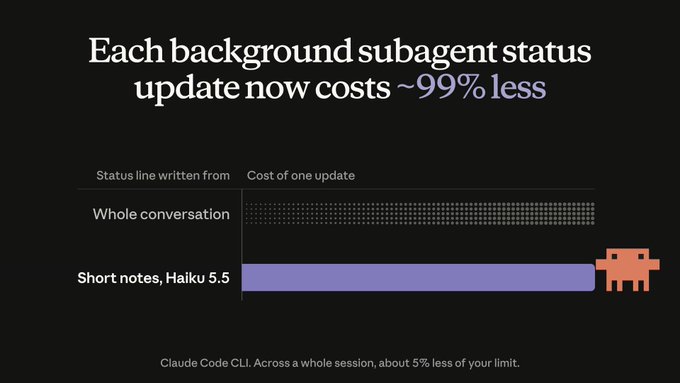
- ClaudeDevs announced the change on November 4, 2026: background subagent status updates now cost about 99% less.
- Haiku 5.5 writes each 30-second status line from short notes instead of rereading the full conversation.
- The cheaper line does not shrink the whole session by 99%; full-session usage is about 5% lower.
At a glance
| Status refresh | Every 30 seconds while a background subagent is running |
|---|---|
| Status writer | Haiku 5.5, from short notes |
| Per-update cost | About 99% lower than rereading the full conversation |
| Session usage | About 5% lower across the whole session |
| Category | AI & Models |
| Creator / publisher | ClaudeDevs |
| Official link | code.claude.com ↗ |
| Heat | 🔥 1.1M Heat |
| Announced | |
| Data updated |
What Haiku 5.5 writes every 30 seconds
Now Haiku 5.5 writes it from short notes instead, so each update costs about 99% less.
Background subagents in Claude Code keep a status line while they run. That line used to be rebuilt by rereading the subagent's whole conversation on every refresh. ClaudeDevs now has Haiku 5.5 produce the same kind of update from short notes, so the status pass no longer drags the full transcript back through the model.
The cadence did not change. A running subagent still updates its status line every 30 seconds. What changed is the input to that refresh: short notes instead of the entire conversation, which is why ClaudeDevs can say each update uses less of your usage limit.
- Old refresh
Each 30-second status update reread the subagent's whole conversation.
- New refresh
Haiku 5.5 writes the line from short notes rather than the full transcript.
- Who announced it
ClaudeDevs, on November 4, 2026, with the docs living on code.claude.com.
Where the savings actually show up
A 99% cut applies to the status update itself, not to every token the subagent spends on the task. ClaudeDevs also frames the practical result at session scale: whole-session usage is about 5% lower, because the status line is only one slice of the work.
The gap matters most when a background subagent stays alive long enough to emit many refreshes. Thirty-second updates add up, and the old path paid a full-conversation read each time. Task work, tool calls, and the main conversation still sit outside this particular saving.
| Measure | Before | After |
|---|---|---|
| Status input | Whole conversation reread | Short notes via Haiku 5.5 |
| Refresh interval | Every 30 seconds | Every 30 seconds |
| Cost of one status update | Full reread each time | About 99% less |
| Whole-session usage | Baseline | About 5% less |
How this fits the subagent docs
The official Claude Code docs on code.claude.com cover creating custom subagents for task-specific workflows and tighter context management. The same docs area includes built-in subagents, a quickstart, configuration, scope, subagent files, and a frontmatter reference, alongside broader sections on agents and parallel work.
You reach the product through Claude Code, with the documentation on code.claude.com. The November 4 change does not publish a separate price list, a new plan, or a new install path. It changes the cost of an existing behavior: the background status line on a subagent that is already running.
What the announcement leaves open
ClaudeDevs states the cost result clearly and does not publish a side-by-side quality check of note-based status lines versus lines written from the full conversation. If you rely on that line to judge whether a long job is stuck, the useful open question is whether the shorter notes stay specific enough after many 30-second cycles.
There is also no new benchmark table and no stated change to how custom subagents are defined. The known limits are the ones in the announcement: about 99% less per status update, about 5% less usage across a session, and a refresh that still happens every 30 seconds.
FAQ
Does a 99% cheaper status update make the whole session 99% cheaper?
No. Each status update costs about 99% less. Across a full session, usage is about 5% lower, because the status line is only one part of what the subagent spends.
Did the refresh schedule change?
No. A running background subagent still updates its status line every 30 seconds. Haiku 5.5 changed how that line is written, not how often it appears.