The short version
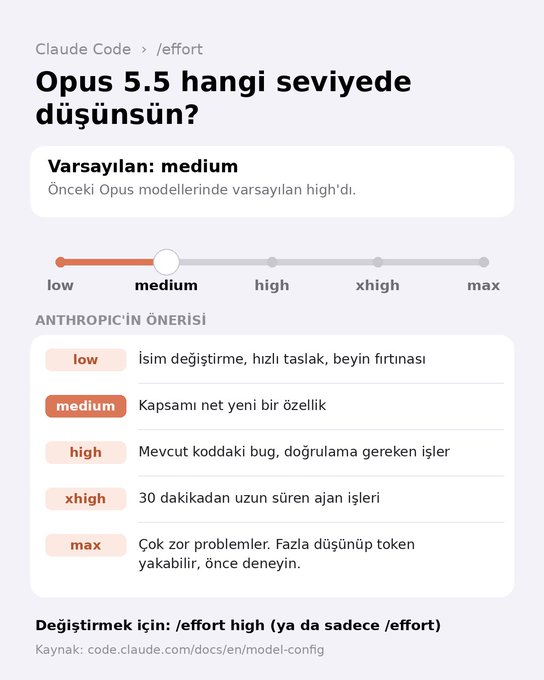
- Why Opus 5.5 Feels Different Out of the Box: The Default Effort Tier Is Now 'Medium' (Environment: Claude Code running Claude Opus 5.5; Control Command: `/effort` slash command (low / medium / high / xhigh / max)).
- Five `/effort` Tiers Compared: Why Leaving 'Max' On Burns Nearly Double the Tokens (Default Setting: Opus 5.5 defaults to `medium` (previous Opus defaulted to `high`)).
- Dynamic Gear-Shifting: `/effort high` for Root-Cause Debugging, `medium` for Implementation (Measured Savings: Using `high` instead of `max` cut a 100M-token debug run down to 56M).
At a glance
| Environment | Claude Code running Claude Opus 5.5 |
|---|---|
| Control Command | `/effort` slash command (low / medium / high / xhigh / max) |
| Default Setting | Opus 5.5 defaults to `medium` (previous Opus defaulted to `high`) |
| Measured Savings | Using `high` instead of `max` cut a 100M-token debug run down to 56M |
| Category | Dev & Open Source |
| Creator / publisher | Eren Özgür |
| Heat | 🔥 21.7K Heat |
| Announced | |
| Data updated |
Why Opus 5.5 Feels Different Out of the Box: The Default Effort Tier Is Now 'Medium'
Developers testing Claude Opus 5.5 inside Claude Code highlighted that the default thinking tier is now set to 'medium' (unlike previous Opus generations that defaulted to 'high') and can be switched anytime via the `/effort` command.
Five `/effort` Tiers Compared: Why Leaving 'Max' On Burns Nearly Double the Tokens
Anthropic's own guidance recommends 'low' for quick renames, 'medium' for scoped features, 'high' for debugging and verification, and reserving 'xhigh' or 'max' for 30+ minute autonomous runs so 'max' does not burn double the tokens overthinking routine edits.
Dynamic Gear-Shifting: `/effort high` for Root-Cause Debugging, `medium` for Implementation
Type `/effort high` when hunting subtle regressions, then drop back to `/effort medium` before asking Claude Code to write boilerplate or tests.
How to try it
Open Claude Code /effort Guide on x.com
Check the supported environment (Using `high` instead of `max` cut a 100M-token debug run down to 56M) and launch x.com from the top button.
Run Through the Core Loop or Setup
Anthropic's own guidance recommends 'low' for quick renames, 'medium' for scoped features, 'high' for debugging and verification, and reserving 'xhigh' or 'max' for 30+ minute autonomous runs so 'max' does not burn double the tokens overthinking routine edits.
Apply Practical Tips for Best Results
Type `/effort high` when hunting subtle regressions, then drop back to `/effort medium` before asking Claude Code to write boilerplate or tests.
FAQ
What engineering problem does Claude Code /effort Guide solve under the hood?
Environment: Claude Code running Claude Opus 5.5; Control Command: `/effort` slash command (low / medium / high / xhigh / max); Default Setting: Opus 5.5 defaults to `medium` (previous Opus defaulted to `high`). Anthropic's own guidance recommends 'low' for quick renames, 'medium' for scoped features, 'high' for debugging and verification, and reserving 'xhigh' or 'max' for 30+ minute autonomous runs so 'max' does not burn double the tokens overthinking routine edits.
How do you integrate or run Claude Code /effort Guide in a local workflow?
Measured Savings: Using `high` instead of `max` cut a 100M-token debug run down to 56M. Type `/effort high` when hunting subtle regressions, then drop back to `/effort medium` before asking Claude Code to write boilerplate or tests.