The short version
- You keep placing peanuts and pistachios in turn, and nothing in the public description asks for anything else.
- Break that alternation and the game promises a harsh scolding, described on the page as terrible sanctions.
- It is free in the browser on game.nishiibe.com and was announced by ニスィーベ on November 4, 2026.
At a glance
| Creator | ニスィーベ |
|---|---|
| Price | Free |
| Where to play | Browser at game.nishiibe.com |
| Announced | November 4, 2026 |
| Category | Web Games |
| Creator / publisher | ニスィーベ |
| Official link | game.nishiibe.com ↗ |
| Heat | 🔥 449.9K Heat |
| Announced | |
| Data updated |
A snack line with one cruel rule
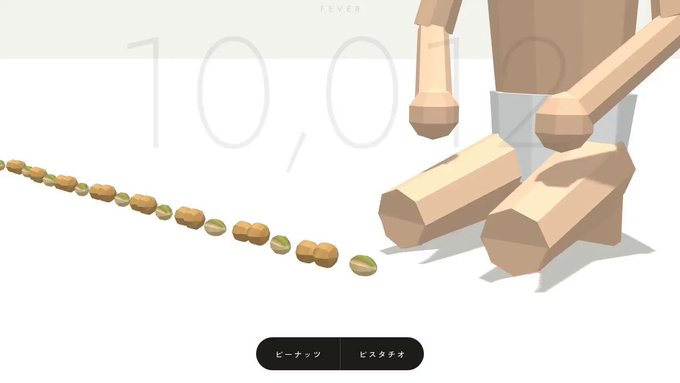
I made a game where, if you do not keep arranging peanuts and pistachios alternately, you get yelled at hard.
The Japanese title is the rulebook. ピーナッツとピスタチオを交互に並べ続けないとめちゃくちゃ怒られるゲーム says you must keep lining up peanuts and pistachios in alternation or you will be scolded hard. The page title repeats that sentence, and a shorter description warns that failing to keep ピーナツ and ピスタチオ alternating brings terrible sanctions.
Creator ニスィーベ introduced it in the same spirit: a game built so that breaking the peanut-pistachio turn order makes someone furious. There is no separate premise hiding under the joke. Two nuts, one order, and a punishment written to sound far bigger than a snack-sorting mistake.
- Peanuts
One of the two items you have to keep placing. A peanut may follow a pistachio, and only a pistachio.
- Pistachios
The other item in the pair. A pistachio may follow a peanut, and only a peanut.
- Alternation
The sequence has to keep switching. The same nut twice in a row is the failure the title is about.
The penalty is the punchline
ピーナツとピスタチオを交互に並べ続けないとひどい制裁を受けます
The comedy is scale. Alternating two familiar nuts is a tiny demand, and the copy treats a slip as something that deserves a furious telling-off. One line says you get yelled at hard. The page description upgrades that to terrible sanctions. Both point at the same beat: the pattern breaks, and the game reacts as if you have committed a serious offense.
What that scolding looks like on screen is not spelled out in the public title or descriptions. The promise you can rely on is the tone. This is a gag about disproportionate anger, not a documented score attack or a ladder of named stages. The satisfaction, as far as the release text goes, is staying inside a rule so simple that blowing it feels absurd, then meeting a reaction written to be much louder than the mistake.
| What you do | What the page says happens |
|---|---|
| You keep peanuts and pistachios alternating | You are obeying the only rule the title states |
| You stop alternating | You are in for a harsh scolding, called terrible sanctions in the description |
| You look for a second system | The published materials do not describe scores, stages, or extra modes |
Staying accurate when the task is boring
The trap is attention, not dexterity. Alternation is easy for three items and slippery after thirty, because each correct placement updates the only fact that matters: which nut just landed. Hesitation is dangerous in a different way from speed. If you cannot name the last nut, you are guessing, and a guess that repeats a nut is exactly the miss the game is built to punish.
Treat the line as a two-beat rhythm rather than a pile of snacks. Say the next nut before you commit to it. If you lose the thread, stop and recover the last placement instead of hoping the sequence will forgive a duplicate. Nothing in the announcement adds multipliers, timers, or safe mistakes, so the sturdy approach is the literal one: never place the same nut twice in a row.
- Name the last nut
Before the next placement, identify whether the line currently ends on peanut or pistachio.
- Call the opposite
The legal next item is always the other nut. If you cannot say it out loud, you are not ready to place it.
- Reset on doubt
A pause beats a duplicate. Re-read the end of the line, then continue the switch.
- Ignore imaginary goals
The release text does not offer a high score to chase. Surviving the pattern is the whole assignment.
How it compares with other tiny web games
A lot of casual browser games ask you to last longer, stack higher, or clear a board. This one publishes a social rule and a comic punishment, then stops. You are not steering a character or managing a resource the page bothers to name. You are obeying a manners lesson about two nuts, enforced with language that belongs to a much worse offense.
That makes it closer to a one-joke reflex test than to a puzzle with hidden depth. The funny part is the mismatch. The satisfying part is how quickly a flawless streak starts to feel fragile. Similar free web gags live or die on whether the single idea is instantly legible. Here the title, the creator's own description, and the page blurb all say the same thing, so you understand the contract before the first nut is placed. It is free, it runs in the browser on game.nishiibe.com, and the Japanese presentation is part of the artifact: the scolding is baked into a title long enough to be the joke.
How to try it
Open the game
Go to game.nishiibe.com in a web browser. The game is free to play there.
Start the alternating line
Arrange peanuts and pistachios so the sequence keeps switching from one to the other.
Track the nut you just used
The next placement has to be the opposite nut. Repeating peanuts or repeating pistachios breaks the rule.
Keep going until you slip
The published win condition is simply not to stop alternating. A break is what triggers the hard scolding and the terrible sanctions named on the page.
FAQ
Is the whole design just the alternation rule?
The title, the creator's introduction, and the page description all center on that single demand. They do not describe separate modes, a point system, or later stages.
What language is the game presented in?
The page title, headings, and descriptions are Japanese. The creator is ニスィーベ, and the game is the Japanese browser release announced on November 4, 2026.