The short version
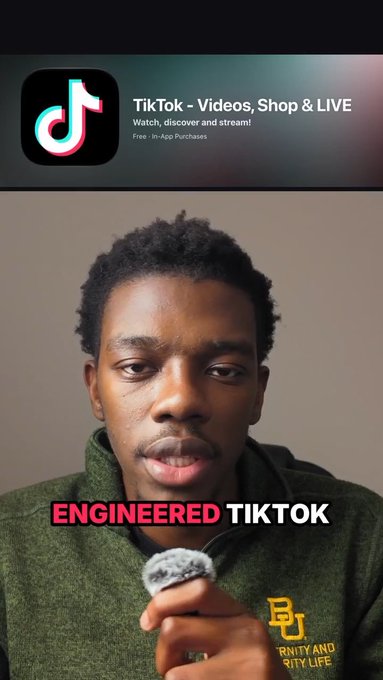
- Ayo O announced on November 3, 2026, with the line "I reverse engineered tiktok," attached to a short preview.
- No public build, download, or official page has been released, so the method and findings cannot be checked yet.
- The interest is about retention design: how a feed decides what you see next, and what a real teardown would need to prove.
A one-line claim and a short preview
I reverse engineered tiktok
On November 3, 2026, Ayo O put that sentence in front of a short preview video. The subject people are treating as recently trending is a claimed reverse engineering of TikTok, framed around retention: the mechanics that decide whether you keep scrolling.
That is the entire public record. The creator has not shipped a build, a download, a write-up, or an official page. Anyone who was not watching the preview has only the caption to go on, and the caption does not name a method, a dataset, or a result.
Why a retention teardown would matter
TikTok's feed is the product. Ordinary users feel retention as the next video arriving before they decide to leave. Developers feel it as a black box: watch time, replays, skips, and whatever else the client reports back, folded into ranking that no outside team can read from a settings screen.
A genuine reverse engineering would matter because it would separate folklore from observable behavior. It could show which signals a client appears to send, how session length is shaped, or which interface choices make quitting slightly harder. It would not, by itself, reveal the full ranking model running on TikTok's servers. Client traces and server-side ranking are different layers, and a preview caption does not say which layer Ayo O touched.
- For people who use the app
The practical question is whether the preview shows levers you can see yourself, such as how interrupts, autoplay, and the next video are sequenced, or only a private demo.
- For people who build feeds
The useful question is whether any of the work is reproducible: captured traffic, a labeled session, or a stated hypothesis. None of that is published yet.
Reactions, and the open questions
Reaction has split along a familiar line. Some viewers treat the preview as a rare look at how a mainstream feed is built to hold attention. Others hear the same claim as a warning: products that study hesitation and reward another scroll can feel manipulative even when the technique is ordinary product work. Both readings are running ahead of the evidence, because the evidence is still a teaser.
What to watch is simple. If Ayo O publishes the method, the captures, or a page where the preview can be replayed in full, the claim becomes something developers can test. Until then, "reverse engineered" is an announcement, not a finding. Open questions are what he actually inspected, whether retention was measured or inferred, and whether any artifact will be released at all.
FAQ
Can you try Ayo O's TikTok reverse engineering yourself?
No. As of the November 3, 2026 announcement, there is no public build, download, or official page. The creator has only shown a short preview.
Did the announcement include TikTok's ranking formula?
No published formula, metric, or method came with the caption. The only quoted claim is "I reverse engineered tiktok."