The short version
- Pieter Levels says Claude Code can design furniture part by part and produce a bill of materials for ordering and self-assembly.
- He claims buying raw materials yourself can cut about 85 percent off premium-brand prices, turning a $30,000 sofa into $4,500 and an $8,000 dinner table into $1,200.
- There is no public build, download, or official page yet, only the short preview he showed.
A table designed in the terminal
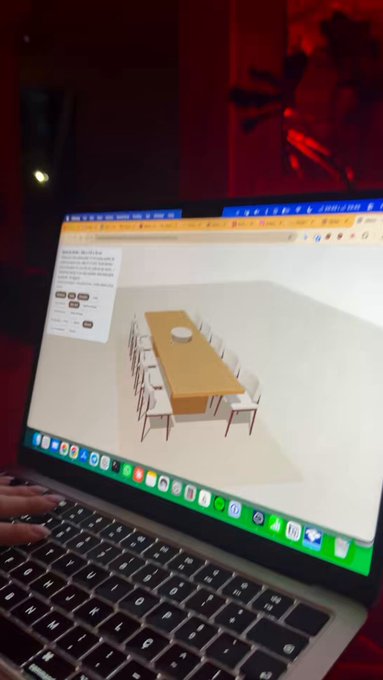
She's not a furniture designer, not a coder, she just had an idea of a style and worked with Claude Code in the terminal.
Levels said Claude Code can design furniture part by part, then hand you a bill of materials so you order each part and put the piece together yourself. The example he walked through was a table designed from scratch. The person behind it, he said, was not a furniture designer and not a coder. She had a style in mind and worked with Claude Code in the terminal, which he called far superior to the app.
Nothing has been released as a product. There is no public build, download, or official page. So far this is a short preview and announcement, not a kit you can open and run.
The markup he wants to skip
If you design your own furniture and buy the raw materials directly, you can save 85% compared to premium brands like Poliform.
The pitch starts from sticker shock while furnishing a house. Levels said basic, cheap materials get a fancy brand attached and the price becomes, in his words, absolutely insane. One shop had a sofa for $30,000. His comparison brand for the savings claim is Poliform.
The 85 percent figure is his estimate, not an audited quote from a supplier. On that math, the $30,000 sofa becomes $4,500 and an $8,000 dinner table becomes $1,200. He reads those gaps as early proof of a broader idea: AI could make many goods 5 times to 20 times cheaper.
| Piece he cited | Premium price | His materials figure |
|---|---|---|
| Sofa | $30,000 | $4,500 |
| Dinner table | $8,000 | $1,200 |
Why shoppers and developers are paying attention
It makes more sense to cut out the middle man and go straight to suppliers.
Levels argues that models such as Opus 5.5 can already operate free 3D programs, naming Blender and FreeCAD. In that setup you describe a style, the model works the geometry part by part, and the output is a shopping list of raw materials instead of a branded catalog number. He says that makes customers more powerful: you get closer to exactly what you want, usually without the showroom markup.
For ordinary buyers, the appeal is control over look and budget. For developers, the interesting part is the workflow itself: a coding agent driving desktop design tools and ending in a parts list a non-coder can act on. The terminal, in his telling, is the place that work actually happens.
- Part-by-part design
Claude Code is described as breaking a piece into components rather than handing back one vague sketch.
- A bill of materials
The practical output is a list of parts to order from suppliers and assemble yourself.
- Free 3D tools
He points to Blender and FreeCAD, both free, as programs models like Opus 5.5 can operate.
What is still unsettled
The savings story depends on materials, finishes, hardware, shipping, and whether a home assembly matches what a premium brand is actually selling. A sofa frame and a showroom sofa are not automatically the same object, and Levels has not published the supplier invoices behind the $4,500 and $1,200 figures. Structural safety, joinery, and local building or fire rules are also outside a chat transcript.
What to watch next is whether the preview becomes a repeatable method: sample bills of materials, the Blender or FreeCAD files, and real orders from people who are not designers. Until a public build or official page exists, the recently trending claim is a demonstrated idea from Pieter Levels, not a finished furniture product.