Key Takeaways
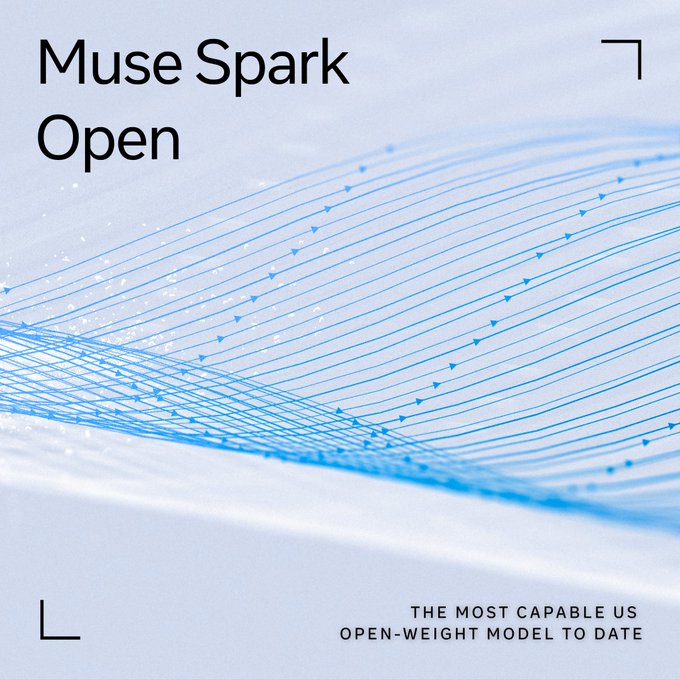
- Muse Spark Open is an open-weight AI model from AI at Meta, announced on October 15, 2026, and positioned as the most capable US open-weight model to date.
- It uses a mixture-of-experts design with 816 billion total parameters and 42 billion active parameters, plus a one-million-token context window and native multimodal input across text, image, video, and audio.
- Meta says it is built for coding and agentic work, targeting long-horizon tasks, complex software engineering, and multi-step reasoning.
- There is no dedicated product page yet; check the official site, ai.meta.com, for weights, license terms, hardware requirements, and availability details.
Quick Facts
| Type | Open-weight multimodal AI model |
|---|---|
| Devices | Servers; Meta says Mac Studio via Apple partnership |
| Price | Not announced; check the official site |
| Languages | Not specified in the announcement |
| Highlight | 816B total / 42B active parameters, 1M-token context |
| Learning curve | Moderate for API users; steep for local deployment |
| Category | AI & Models |
| Creator | AI at Meta |
| Official site | ai.meta.com ↗ |
| Heat | 🔥 1.2M Heat |
| Last updated |
What Muse Spark Open Is and Why It Is Getting Attention
Muse Spark Open is an open-weight AI model released by AI at Meta on October 15, 2026. Meta describes it as the most capable US open-weight model to date, a claim that matters because open-weight releases let outside developers download, inspect, fine-tune, and self-host a model instead of only calling it through a closed API. The model is aimed squarely at coding and agentic work: long-horizon tasks, complex software engineering, and multi-step reasoning where a model must plan, use tools, and keep track of many moving parts over time.
The headline numbers are unusually large for an open release. Muse Spark Open uses a mixture-of-experts architecture with 816 billion total parameters and 42 billion active parameters per token, which means only a fraction of the network runs for each request. It also offers a one-million-token context window and native multimodal input across text, image, video, and audio. Meta says the model can run on a Mac Studio through an Apple partnership, a combination that has surprised observers because an 816B model running on desktop hardware is not something most people expect.
There is no dedicated page for this title yet, so treat the announcement as the starting point rather than the full specification. Details such as the exact license, supported languages, quantization options, and hardware requirements still need to be confirmed on the official site, ai.meta.com. If you are evaluating it for a team, plan to verify those details yourself before you commit engineering time or infrastructure budget.
- Open weights, not just an API
Open-weight means the model parameters are distributed so you can run or adapt them yourself, subject to whatever license Meta attaches. That is a different proposition from a hosted-only model.
- Built for agents and coding
Meta frames Muse Spark Open around long-horizon tasks and complex software engineering, so expect tool use, repository-scale reasoning, and multi-step planning to be the main evaluation scenarios.
- A one-million-token context window
A context window that large can hold very long documents or large codebases in a single prompt, but effective use depends on how well the model retrieves and reasons over distant parts of the input.
- Native multimodality
Text, image, video, and audio input are described as native rather than bolted on, which matters for tasks that mix screenshots, recordings, and written instructions.
Inside the Architecture: Mixture of Experts, 816B Parameters, and 1M Context
The mixture-of-experts design is the key to understanding the size numbers. Muse Spark Open has 816 billion total parameters, but only about 42 billion are active for any given token. In a mixture-of-experts model, a routing mechanism sends each token to a small subset of specialized expert networks instead of running the whole model. That keeps inference cost closer to a 42B-class model while the total parameter count carries far more stored knowledge and capacity. It is the same broad idea used by several large open models, and it is why the model can be both enormous and, in principle, practical to serve.
The one-million-token context window is the second pillar. Long context is especially valuable for agentic coding, where the model may need to hold an entire repository, a long issue thread, test output, and a chain of tool results at once. In practice, long-context quality varies: models can lose track of details in the middle of a very long prompt, so you should test retrieval and reasoning at your real working length rather than trusting the maximum number. Meta has not published benchmark figures in the announcement, so independent evaluations are the place to look.
Native multimodality across text, image, video, and audio rounds out the specification. Native support generally means the model was trained to handle these modalities together rather than through separate adapters, which can help on tasks like reading a UI screenshot, listening to a bug report recording, and then writing a fix. Meta has not detailed how each modality is encoded, how video and audio are sampled, or what limits apply, so check the official site for the technical report if you need those specifics.
- Total vs. active parameters
816B total and 42B active means the model stores a great deal of capacity but only spends a fraction of it per token. Memory footprint still depends on how the weights are quantized and how many experts are resident.
- What long context is good for
Repository-wide refactors, long incident timelines, and multi-document analysis are the natural fits. Test at your real prompt length, because maximum context and usable context are not the same thing.
- Multimodal input, not necessarily output
The announcement describes native multimodal input across text, image, video, and audio. It does not promise matching output modalities, so verify what the model can generate before designing around it.
How to Try Muse Spark Open: Weights, Local Runs, and a Sensible Test Plan
Because Muse Spark Open is an open-weight release, the practical path starts with obtaining the weights from Meta's official release page and reading the license carefully. Open weights are not the same as unrestricted use: licenses often include acceptable-use terms, redistribution conditions, and sometimes thresholds that change obligations for large commercial deployments. Before you download hundreds of gigabytes, confirm the license, the intended hardware, and whether Meta provides reference inference code or recommended serving frameworks.
The most talked-about deployment detail is Meta's statement that the model can run on a Mac Studio through an Apple partnership. That is a notable claim for a model of this size, and it suggests Meta has worked on quantization or memory optimization for Apple silicon. Treat it as a supported path rather than a guarantee of performance: check the official site for the exact Mac Studio configurations, memory requirements, and expected throughput. If you do not have that hardware, a hosted endpoint or a cloud GPU instance may be the faster way to evaluate the model.
Whatever route you take, test the model against your own work before committing. A good first evaluation is a real repository with a genuine task, such as tracing a bug across several files or adding a feature that touches tests and documentation. Measure whether the model uses the full context effectively, how often it needs correction, and what it costs in time and hardware. Benchmarks and demos are useful signals, but your workload is the only benchmark that decides whether Muse Spark Open belongs in your stack.
- Read the license first
Open weights come with terms. Check acceptable use, redistribution, and any commercial thresholds on the official site before you build a product on top of the model.
- Start with one real repository
Pick a codebase you know well and a task with a clear definition of done. That reveals long-context behavior and agentic reliability far better than a toy prompt.
- Compare local and hosted costs
A Mac Studio run and a cloud GPU run have very different cost profiles. Estimate memory, throughput, and electricity or hourly rates before deciding which is your default.
How It Compares, Where It Fits, and What Remains Unclear
Muse Spark Open enters a crowded field of capable open-weight models, many of which also use mixture-of-experts designs and long context windows. Meta's differentiators here are the combination of scale, native multimodality, and the claim of desktop-class local execution through the Apple partnership. If you are choosing between open models, compare them on the axes that matter to you: coding and agentic task success, long-context accuracy, multimodal handling, license terms, and the hardware you can actually afford to run.
The realistic use cases follow from the specification. Teams doing large-scale software engineering can use it for repository-aware refactoring, test generation, and multi-step debugging. Agent builders can use it as the reasoning core for workflows that call tools over long horizons. Analysts can feed it long documents, recordings, and screenshots together. Because the model is open-weight, organizations with data-residency or customization needs can fine-tune or self-host rather than sending everything to a third-party API.
Several questions remain open. Meta has not published benchmark numbers in the announcement, so claims of being the most capable US open-weight model should be checked against independent evaluations. The exact license, supported languages, quantization options, and Mac Studio configurations are also unconfirmed. There is no dedicated product page yet, so the official site, ai.meta.com, is the place to watch for the technical report, weights, and terms. If you need certainty today, verify each detail there rather than relying on secondhand summaries.
- Versus other open-weight models
Compare on your own tasks, not just parameter counts. Mixture-of-experts models with similar totals can behave very differently in coding, long-context retrieval, and tool use.
- Versus closed hosted models
Open weights give you control, customization, and data residency, but you take on serving cost and operational work. Closed APIs are simpler but lock you into someone else's terms and roadmap.
- Who should wait
If you need guaranteed support, published benchmarks, or a stable long-term license today, wait for the official documentation and independent evaluations before committing.
Step-by-Step Guide
Check the official announcement and license
Go to the official site, ai.meta.com, and read the Muse Spark Open release details, including the license and acceptable-use terms. Confirm what you are allowed to do commercially and how redistribution works before you download anything.
Get the weights and reference code
Download the model weights from Meta's official release page and look for any reference inference or serving code the company provides. Note the file sizes and formats, because an 816B-parameter model requires substantial storage and memory planning.
Choose your runtime: Mac Studio or cloud
If you have a supported Mac Studio configuration, follow Meta's guidance for running the model locally through the Apple partnership. Otherwise, use a cloud GPU instance or a hosted endpoint to evaluate the model without buying hardware.
Test the one-million-token context on real work
Load a real repository or a long document set and give the model a task that requires reasoning across distant parts of the input. Check whether it retrieves the right details and how much correction it needs.
Evaluate agentic and multimodal tasks
Run a multi-step workflow with tool calls, then try a task that mixes text, images, video, or audio. Record success rates, latency, and cost so you can compare Muse Spark Open fairly against your current model.
Frequently Asked Questions
What is Muse Spark Open?
Muse Spark Open is an open-weight AI model from AI at Meta, announced on October 15, 2026. Meta describes it as the most capable US open-weight model to date, built for coding and agentic work. It has 816 billion total parameters, 42 billion active parameters, a one-million-token context window, and native multimodal input across text, image, video, and audio.
How do I access Muse Spark Open?
There is no dedicated page for this title yet. Meta's official site, ai.meta.com, is the place to check for the weights, license, and technical documentation. Because it is an open-weight release, you should expect to download the model and run it yourself or through a hosting provider, rather than only using a hosted chat interface.
Can Muse Spark Open really run on a Mac Studio?
Meta says the model can run on a Mac Studio through an Apple partnership, which is notable for a model with 816 billion total parameters. The exact supported configurations, memory requirements, and performance expectations have not been detailed in the announcement. Check the official site for the specific hardware guidance before assuming your machine qualifies.
How does Muse Spark Open compare with other open-weight models?
It competes on scale, native multimodality, long context, and the claim of local desktop execution. Many other open-weight models also use mixture-of-experts designs, so parameter counts alone do not tell you which is better. Compare them on your own coding, agentic, and long-context tasks, and weigh license terms and hardware costs alongside raw capability.
What are the main limitations or open questions?
Meta has not published benchmark numbers in the announcement, so the claim of being the most capable US open-weight model needs independent verification. The exact license, supported languages, quantization options, and Mac Studio configurations are also unconfirmed. There is no dedicated product page yet, so verify every detail on the official site, ai.meta.com, before committing to deployment.