The short version
- Ornith-1.5-122B is a mixture-of-experts text model with 122 billion total parameters and 10 billion active on each pass, released under the MIT license.
- Ornith reports strong coding and agentic scores and says the model runs on a single NVIDIA DGX card.
- Source code and instructions are in the official repository on huggingface.co, and a 35GB compressed build is on Ollama for a Mac with 64GB of memory.
At a glance
| Architecture | Mixture of experts, 122B total, 10B active |
|---|---|
| License | MIT, open weights |
| Where to get it | huggingface.co repository and Ollama |
| Local footprint | 35GB compressed build, 64GB-memory Mac |
| Category | AI & Models |
| Creator / publisher | Ornith |
| Official link | huggingface.co ↗ |
| Heat | 🔥 1.5M Heat |
| Announced | |
| Data updated |
A leaner frontier model from Ornith
No tradeoff between strong and fast. Stronger. Faster. Leaner.
Ornith introduced Ornith-1.5-122B as an open-weight programming and text-generation model. The release uses a mixture-of-experts layout: 122 billion parameters in total, with 10 billion activated on each forward pass. Ornith frames that design as frontier-level capability with exceptional inference efficiency, including a claim that it runs on a single NVIDIA DGX card.
The company highlights stronger instruction following, stronger task decomposition, and a deeper read of real-world workflows, and it calls the result state of the art among open-source models of comparable size. Weights ship under the MIT license. The model card on huggingface.co treats it as a text-generation model and documents benchmarks, a quickstart, serving, the Chat Completions API, agentic usage, and coding CLIs.
Coding and agent scores Ornith published
We can’t wait to see what you build with Ornith-1.5-122B.
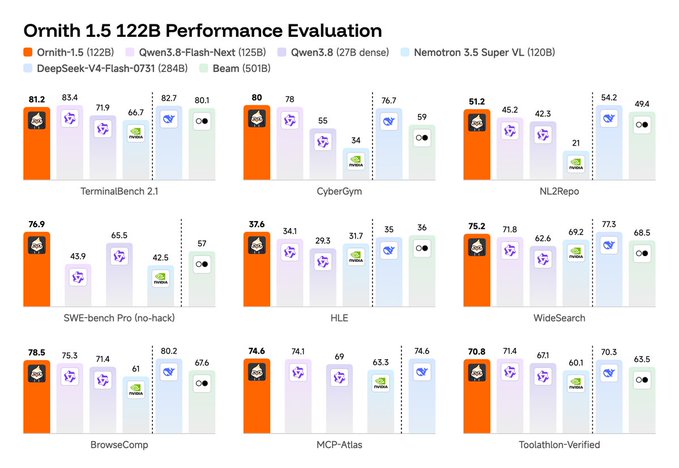
The announcement splits results into coding and agentic suites. On coding, Ornith lists SWE-bench Verified at 0.845, TB2.1 at 0.813, CyberGym at 0.800, and NL2Repo at 0.512. On agentic work, it lists HLE at 0.446, BrowseComp at 0.785, MCP-Atlas at 0.746, and Toolathlon at 0.708.
Those figures are Ornith’s own reported scores for this release. The notes do not include a side-by-side table against named rival models, hardware throughput numbers, or context-length specs, so the public comparison is the company’s claim of leading open-source results at this size plus the raw benchmark list.
| Suite | Benchmark | Reported score |
|---|---|---|
| Coding | SWE-bench Verified | 0.845 |
| Coding | TB2.1 | 0.813 |
| Coding | CyberGym | 0.800 |
| Coding | NL2Repo | 0.512 |
| Agentic | HLE | 0.446 |
| Agentic | BrowseComp | 0.785 |
| Agentic | MCP-Atlas | 0.746 |
| Agentic | Toolathlon | 0.708 |
Where you can actually run it
Availability is concrete. Source code and instructions live in the official repository on huggingface.co, under the ornith-ai collection for Ornith-1.5-122B. The model card covers a quickstart, serving the model, calling it through the Chat Completions API, agentic usage, and coding CLIs.
A separate path is already live on Ollama. The compressed build is 35GB and is described as runnable locally on a Mac with 64GB of memory. That is the practical split: full open weights and serving docs on Hugging Face for people who want to host it, and a smaller Ollama package for a high-memory desktop. Pricing, rate limits, and a hosted API price list are not part of this release note. Use stays under the MIT license on the weights themselves.
What is still open
The efficiency story rests on the 10-billion-active expert design and the single NVIDIA DGX card claim. Independent latency, tokens-per-second, and multi-GPU scaling numbers are not in the announcement, so you should treat “faster and leaner” as Ornith’s positioning until you measure a build on your own hardware.
NL2Repo at 0.512 is the clear outlier next to the other coding scores above 0.80, and HLE at 0.446 sits well below the other agentic marks. If you are choosing it for repository-level natural-language tasks or for the hardest agent evaluations, read those two numbers before you assume the headline scores transfer. Citation guidance is on the model card if you need to credit the release in research.
How to try it
Open the official repository
Go to the Ornith-1.5-122B repository on huggingface.co. The card includes the quickstart plus notes on serving, the Chat Completions API, agentic usage, and coding CLIs.
Pick a runtime
Serve the open weights from that repository, or pull the compressed 35GB build on Ollama if you have a Mac with 64GB of memory.
Match the workload to the scores
Use it for instruction following, coding, tool use, and workflow-style agents. Check SWE-bench Verified, TB2.1, CyberGym, BrowseComp, MCP-Atlas, and Toolathlon against NL2Repo and HLE before you commit a hard repository or evaluation job.
FAQ
Is Ornith-1.5-122B open weight, and under what license?
Yes. Ornith released the weights as open weights under the MIT license, with source code and instructions in the official repository on huggingface.co.
Can you run Ornith-1.5-122B on a Mac?
The compressed build is 35GB and is described as runnable locally on a Mac with 64GB of memory through Ollama. Ornith also says the model runs on a single NVIDIA DGX card.