The short version
- Vork is a Rust and Slang headless 3D/VFX engine whose core API is about 2,500 tokens, built so agents write the scene themselves.
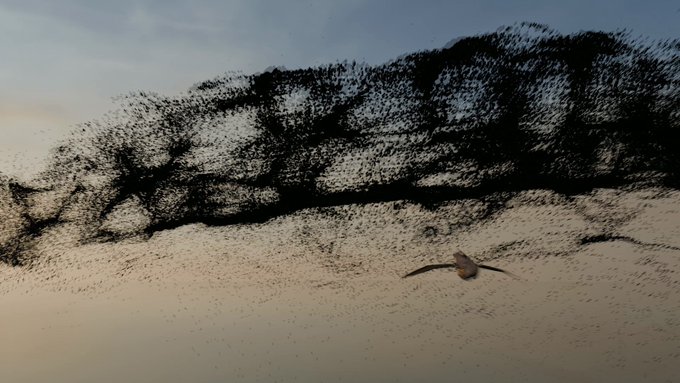
- A public demo rendered one million birds, each on a unique trajectory, in 97 seconds on a single NVIDIA L4 GPU.
- The project is a research preview: start from the voyager-so/vork repository and the Paste this to your agent section.
At a glance
| Stack | Rust and Slang, GPU via Metal or Vulkan |
|---|---|
| Core API | About 2,500 tokens |
| Status | Research preview, source on github.com |
| Creator | Ravi Parikh, Voyager |
| Category | Dev & Open Source |
| Creator / publisher | Ravi Parikh |
| Official link | github.com ↗ |
| Heat | 🔥 603.2K Heat |
| Announced | |
| Data updated |
An engine agents can author, not click through
Dear Claude: you are being held back by human-centric graphics APIs.
Ravi Parikh built Vork because agents keep getting stuck inside tools designed around a person at a screen. Blender, Unreal Engine, and Houdini assume menus, viewports, and long parameter lists. Vork is headless: the agent writes shaders, materials, cameras, and physics, then takes the scene from setup through render in a short description.
The core API is sized to fit in about 2,500 tokens. Parikh claims that compactness makes Vork twice as token-efficient as those three human-facing tools, because the agent does not have to ferry a large bag of parameters just to describe a shot. Rendering runs on the GPU through Metal or Vulkan. Repository topics also cover ray tracing, so agents are expected to drive tracing as well as conventional scene rendering.
One million birds in 97 seconds
Up to 24x faster rendering times
The showcase simulation puts one million birds in frame, each with its own trajectory, and reports a finished render in 97 seconds on one NVIDIA L4 GPU. The same job in Blender EEVEE is reported at 31 minutes. Parikh also states rendering can be up to 24 times faster; treat that as his ceiling claim, separate from this single flock comparison.
Other scenes shown with the project include VFX laid over live-action footage, a piece titled After Rain, and a black hole. Together they sketch the intended range: large agent-authored simulations and compositing work, not a single demo trick.
| Run | Hardware | Reported time |
|---|---|---|
| Vork, 1 million birds | One NVIDIA L4 GPU | 97 seconds |
| Blender EEVEE, same job | Reported comparison | 31 minutes |
What you can run today
Paste this to your agent
Source and instructions live in the public voyager-so/vork repository on github.com, also linked from voyager.so/vork. The README labels the project a research preview and opens with a section named Paste this to your agent, plus a Start here path. Topics on the repo read 3d, ai-agents, gpu, metal, ray-tracing, rendering, rust, slang, vfx, and vulkan.
A practical loop is to hand that paste block to your agent, let it author materials, cameras, and physics against the compact API, then render on a Metal or Vulkan GPU. The early repo is still a research preview, so expect a small surface area and the limits of a young engine rather than a full studio suite.
- Agent-written shading
Shaders and materials are part of the API the agent is meant to write, not a panel you configure by hand.
- Cameras and physics
Camera and physics setup sit in the same short API, so one description can cover look and motion.
- GPU backends
The engine targets Metal and Vulkan. The million-bird timing was measured on one NVIDIA L4.
How to try it
Open the repository
Go to voyager-so/vork on github.com, or start from voyager.so/vork. Read the research-preview README before you point an agent at it.
Paste the agent block
Use the README section labeled Paste this to your agent, then follow Start here so the agent gets the core API instead of a human GUI walkthrough.
Render on Metal or Vulkan
Have the agent author shaders, materials, cameras, and physics, then run the GPU render. Use the million-bird, After Rain, black hole, and live-action VFX examples as patterns for scene scale.
FAQ
Is Vork a finished DCC app for artists?
It is a research preview of a headless engine. Agents drive it through a compact API on Metal or Vulkan, and the public entry point is the source repository.
Where do the speed numbers come from?
Parikh reports the million-bird simulation at 97 seconds on one NVIDIA L4, against 31 minutes in Blender EEVEE, and separately claims up to 24 times faster rendering and 2 times better token efficiency versus Blender, Unreal Engine, and Houdini.