Key Takeaways
- Grok Voice 3.0 is a speech-to-speech model announced by SpaceX Super Intelligence on October 14, 2026, described as the world's most intelligent voice model and aimed mainly at customer service calls.
- According to the announcement, it converts spoken input straight into spoken output without a separate text step, responds in under one second, and costs less than other frontier voice models.
- There is no dedicated product page yet; the company's official site is grok.com, and the model is listed with API as its access attribute, so treat availability details as unconfirmed until the official site says otherwise.
- Start with short customer-service style calls to judge latency and tone before trusting it with long or high-stakes conversations.
Quick Facts
| Type | Speech-to-speech voice AI model |
|---|---|
| Devices | Cloud-based; browser and API access |
| Price | Claimed cheaper than frontier rivals; check official site |
| Languages | Not specified in the announcement |
| Highlight | Sub-second responses for customer calls |
| Learning curve | Low for callers; moderate for API integration |
| Category | AI & Models |
| Creator | SpaceX Super Intelligence |
| Official site | grok.com ↗ |
| Heat | 🔥 3M Heat |
| Last updated |
What Grok Voice 3.0 Actually Is
Grok Voice 3.0 is a speech-to-speech AI model announced by SpaceX Super Intelligence on October 14, 2026. In the announcement, the company calls it the world's most intelligent speech-to-speech model and says it excels at resolving customer calls. That framing matters: this is not a general chatbot with a voice layer bolted on, but a model designed around live spoken conversation, especially the kind of back-and-forth that happens on a support line.
The core technical claim is that it converts spoken input directly into spoken output without a separate text step. Many voice assistants work in a chain: speech recognition turns your words into text, a language model writes a reply, and a text-to-speech engine reads it aloud. Each link adds delay and can lose tone or nuance. A direct speech-to-speech pipeline is meant to shorten that chain, which is how the company can claim responses in under a second.
The model is listed with API as its access attribute, meaning the intended route is programmatic integration rather than a standalone consumer app. Pricing is described only as lower than other frontier models, with no figures published. Because no dedicated page exists yet, treat every specification beyond the announcement as unconfirmed and verify details on the official site, grok.com, before planning a deployment.
- Speech in, speech out
The model is designed to skip the intermediate text transcript, which can preserve tone and cut latency compared with chained voice pipelines.
- Built for calls, not chat
The announcement highlights resolving customer calls, so expect the model to be tuned for turn-taking, interruptions and task completion rather than open-ended chat.
- API-first access
With API listed as the access attribute, developers should plan for integration work rather than expecting a ready-made phone app.
Why Sub-Second Latency Changes a Phone Call
In human conversation, gaps longer than roughly a second start to feel like hesitation or disconnection. That is why latency, not raw intelligence, is often the deciding factor in whether a voice agent feels usable. A model that answers in under a second can approximate natural turn-taking, letting callers speak, hear a reply and respond without the awkward pauses that make people hang up or ask for a human.
Direct speech-to-speech processing helps here because it removes handoffs. Every conversion between audio and text costs time and can flatten emotion, accent and emphasis. By working on speech end to end, the model has a chance to pick up on how something is said, not just what was said, which is useful when a caller is frustrated, confused or in a hurry.
The cost claim is the other half of the pitch. Customer service is a high-volume workload, so per-minute pricing dominates the economics of any deployment. If Grok Voice 3.0 is genuinely cheaper than other frontier voice models, it could make automated call handling viable for smaller teams. No published rate exists yet, so compare quotes on the official site before budgeting.
- Latency beats eloquence
A slightly less clever answer delivered instantly often feels better on a call than a brilliant one delivered after three seconds of silence.
- Tone survives the pipeline
Skipping a text transcript can keep frustration, urgency and hesitation audible, which helps the model decide when to escalate.
- Volume economics
Call centers measure cost per minute, so a lower frontier-tier price is the claim most likely to drive adoption.
How to Try It Without a Product Page
Because there is no dedicated page for Grok Voice 3.0 yet, the practical starting point is the company's official site, grok.com. Check there for an API section, model documentation or a waitlist. If the model is exposed through an API, you will typically need an account, a key and a small test script before you can judge anything for yourself.
When you do get access, resist the temptation to test with a long, complicated scenario first. Short customer-service style calls are the best initial probe: a billing question, a delivery delay, a password reset. These exchanges are brief, have a clear goal and reveal quickly whether the latency claim holds and whether the voice sounds natural or synthetic.
Log what you observe. Note the delay between your last word and the model's first, whether it interrupts or waits, how it handles a correction mid-sentence, and whether it stays on task. Those notes will tell you more about production readiness than any benchmark chart, and they give you concrete questions to raise with the vendor.
- Start with a scripted call
Write a five-turn support scenario and run it repeatedly; consistency across runs matters more than one impressive demo.
- Test the interruption
Talk over the model deliberately to see whether it yields, stops or talks through you, since real callers interrupt constantly.
- Measure, do not guess
Time the gap between your final word and the first syllable of the reply on several calls before accepting the sub-second claim.
How It Stacks Up Against Rival Voice Models
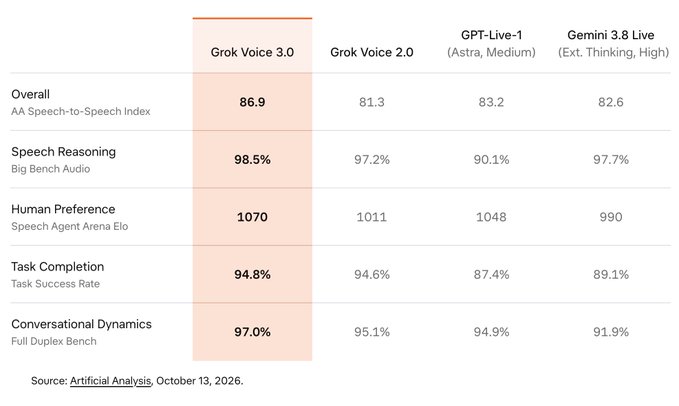
Grok Voice 3.0 enters a field where several frontier labs already offer real-time voice systems, and users are comparing it on two axes: sub-second latency and low cost. Those are the claims the announcement leans on, and they are also the easiest to verify in a side-by-side test. If you already run another voice model, route the same scripted calls through both and compare delay, tone and task completion.
The honest limitation is that almost everything beyond the announcement is unknown. Supported languages are not specified. Context length, voice options, accent coverage, data handling and compliance certifications are not stated. For customer service work, those details matter as much as latency, because call recording rules and regional privacy law often dictate what you can deploy.
The model suits teams that handle high volumes of short, structured calls and want to experiment with automation at frontier quality. It is a poor fit for anyone who needs guaranteed uptime, published SLAs or regulated-industry compliance today, because none of that is confirmed. Watch the official site for documentation, and treat any third-party summary as provisional until the vendor publishes specifics.
- Compare on your own scripts
Vendor benchmarks rarely match your call mix; the same five scenarios run on two models is a fairer test.
- Unknowns to chase
Languages, voice variety, data retention and compliance are all unstated, so ask the vendor directly before committing.
- Who should wait
Regulated industries and mission-critical lines should hold off until SLAs and privacy terms are published.
Step-by-Step Guide
Check the official site for access
Go to grok.com and look for an API or developer section mentioning Grok Voice 3.0. Since no dedicated product page exists yet, availability may be limited or waitlisted. Note what the site actually promises before you build anything around it.
Set up credentials and a test environment
If API access is offered, create an account and generate a key. Keep the first tests in a sandbox rather than a live phone line. Confirm the supported audio formats and any rate limits in the documentation before writing code.
Run short scripted calls
Build a handful of brief customer-service scenarios with a clear goal, such as a refund request or a delivery question. Run each one several times. Short calls expose latency and tone problems faster than long, meandering conversations.
Measure latency and tone
Time the pause between your last word and the model's first, and note whether the voice sounds natural. Deliberately interrupt and correct yourself mid-sentence. Record whether the model recovers gracefully or loses the thread.
Decide, then scale carefully
Compare your notes against your current voice setup on cost per call and completion rate. If results hold, expand to more scenarios gradually. Keep a human escalation path in place, since the model's limits on edge cases are not yet documented.
Frequently Asked Questions
What is Grok Voice 3.0?
It is a speech-to-speech AI model announced by SpaceX Super Intelligence on October 14, 2026. The company describes it as the world's most intelligent speech-to-speech model, built mainly for resolving customer service calls. It converts spoken input directly into spoken output without a separate text step, according to the announcement.
How much does Grok Voice 3.0 cost?
No price has been published. The announcement only claims it costs less than other frontier models, without giving figures or tiers. Since customer service economics depend heavily on per-minute pricing, check the official site, grok.com, for current rates before you budget for a deployment.
How do I access Grok Voice 3.0?
There is no dedicated product page yet, and the model is listed with API as its access attribute, so the intended route is programmatic integration. Start at the company's official site, grok.com, and look for developer documentation or a waitlist. Availability may be limited while the model rolls out.
Is the sub-second response claim realistic?
It is plausible because the model skips the intermediate text step that chained voice pipelines rely on, and that handoff is a major source of delay. That said, real-world latency also depends on your network, audio setup and server load. Test it yourself with short calls before accepting the claim.
Which languages and voices does it support?
The announcement does not specify supported languages, voice options or accent coverage. For customer service work these details are critical, especially if you handle multilingual callers. Treat any list you see elsewhere as unconfirmed and verify directly with the vendor or on the official site.