The short version
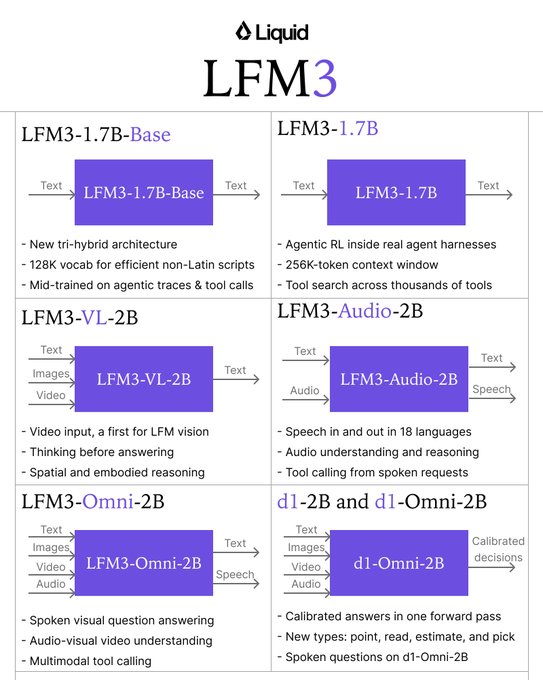
- Six open-weight models in the 2B parameter class built on the shared LFM3-1.7B-Base: LFM3-1.7B, LFM3-VL-2B, LFM3-Audio-2B, LFM3-Omni-2B, d1-2B, and d1-Omni-2B.
- Uses a tri-hybrid architecture tuned for 14 processor classes across GPUs, CPUs, and NPUs, and can be fine-tuned into domain specialists on a single GPU.
- LFM3-1.7B offers a 256K context window for running thousands of parallel tiny agents, while LFM3-VL-2B (1.9B parameters) adds video input for spatial understanding.
- Weights are live on Hugging Face in BF16, GGUF, ONNX, MLX, FP8, and NVFP4 formats with day-zero support in SGLang and Ollama.
At a glance
| Developer | Liquid AI |
|---|---|
| Model lineup | 6 models (~1.7B to 2B parameters on shared LFM3-1.7B-Base) |
| Modalities | Text (256K), Vision + Video, 18-lang Audio, Omni, Calibrated Decision |
| Export formats | Safetensors, GGUF, ONNX, Apple MLX, FP8, NVFP4 |
| Runtime support | Day-zero SGLang and Ollama; fine-tunes on 1 GPU |
| Category | AI & Models |
| Creator / publisher | leonie |
| Official link | huggingface.co ↗ |
| Heat | 🔥 24.3K Heat |
| Announced | |
| Data updated |
Six 2B-class specialists built on a single tri-hybrid base
Rather than shipping one oversized generalist checkpoint, Liquid AI structured the initial LFM3 release as six compact models sharing the same LFM3-1.7B-Base backbone. By combining a new tri-hybrid architecture with updated multimodal encoders, the family targets edge deployment and high-throughput server workloads across 14 processor classes spanning GPUs, CPUs, and NPUs.
Because every variant sits in the 1.7B-to-2B parameter range, teams can fine-tune any of the six checkpoints on a single GPU to build narrow domain specialists, or run thousands of tiny agents in parallel without the memory overhead of 30B-plus models.
- LFM3-1.7B (Text)
Features a 256K context window engineered for running large fleets of lightweight agents in parallel.
- LFM3-VL-2B (Vision & Video)
A 1.9B-parameter vision-language model with video-input support for spatial understanding that competes with Gemma 4 12B and Gemini 3.5 Flash Lite.
- LFM3-Audio-2B & LFM3-Omni-2B
Audio-2B handles speech-in and speech-out with tool calls across 18 languages, while Omni-2B unifies vision, audio, and language in one checkpoint.
What the d1-2B and d1-Omni-2B decision models do differently
Alongside the four generative checkpoints, Liquid AI introduced a new model category inside the collection: d1-2B and d1-Omni-2B. Instead of streaming free-form chat paragraphs, these decision models emit strictly typed outputs accompanied by calibrated probabilities in a single forward pass.
In production pipelines—such as routing, classification, moderation, or voice-driven triage where d1-Omni-2B accepts direct audio input—getting a typed decision and a calibrated confidence score in one pass avoids brittle regex parsing and multi-token decoding latency.
Ready-to-run quantizations from Apple MLX to NVFP4
Inside the official LiquidAI LFM3 collection on Hugging Face, each model ships alongside pre-converted deployment repositories including GGUF for local runners, ONNX for cross-platform runtimes, MLX for Apple Silicon Macs, FP8, and NVFP4.
Both SGLang and Ollama added day-zero support for the lineup, allowing developers to pull and test the 2B checkpoints locally or benchmark them on high-concurrency inference servers immediately.
How to try it
Open the LiquidAI LFM3 collection on Hugging Face
Use the button above to browse all six base and post-trained checkpoints plus their quantized variants.
Pick the modality and format for your hardware
Choose LFM3-1.7B for text agents, VL-2B for image/video, Audio-2B or Omni-2B for speech, and select GGUF, MLX, ONNX, FP8, or NVFP4.
Run locally with Ollama or serve via SGLang
Launch the model with day-zero support in Ollama on a laptop or SGLang on a GPU server, or fine-tune on a single GPU.
FAQ
Which six models are included in the first LFM3 release?
The release includes LFM3-1.7B (text), LFM3-VL-2B (vision and video), LFM3-Audio-2B (speech in/out), LFM3-Omni-2B (vision, audio, language), d1-2B (decision model), and d1-Omni-2B (multimodal decision model).
How large is the context window on LFM3-1.7B?
LFM3-1.7B supports a 256K token context window.
What are d1-2B and d1-Omni-2B?
They are specialized decision models that return typed outputs and calibrated probabilities in a single pass, with d1-Omni-2B adding audio input support.
What hardware and quantization formats are supported?
The tri-hybrid architecture is optimized for 14 processor classes across GPUs, CPUs, and NPUs, with weights published in GGUF, ONNX, MLX, FP8, and NVFP4 alongside SGLang and Ollama support.