Key Takeaways
- Majority or Die is a free browser game by KSK Daze Games that asks you to choose the same answer as the crowd to survive each round.
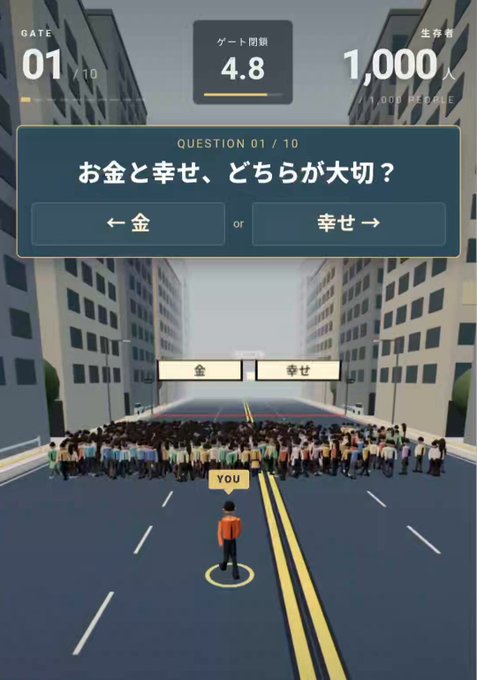
- You run alongside 1,000 simulated people and must clear 10 questions by entering the gate where most of them gather, not the one you personally prefer.
- Controls support dragging on touchscreens and arrow keys or WASD on desktop, and the game runs on smartphones and computers directly in the browser.
- The core skill is crowd-reading: watch where the bulk of the crowd drifts before you commit, because your own taste does not matter.
Quick Facts
| Type | Free browser game |
|---|---|
| Devices | Smartphones and desktop browsers |
| Price | Free to play |
| Languages | Japanese; check official site for others |
| Highlight | 10 rounds against a 1,000-person crowd |
| Learning curve | Easy to start, hard to survive |
| Category | Browser Games |
| Creator | KSKだぜGAMES |
| Official site | kskdazegames.com ↗ |
| Heat | 🔥 1.4M Heat |
| Last updated |
What Majority or Die Actually Is
Majority or Die is a casual browser game created by KSK Daze Games and announced on October 16, 2026. The Japanese title translates roughly to a game where you die if you do not become the majority. The premise is blunt: each round presents a question, and you must choose the same answer as most of the 1,000 simulated people running alongside you. If you pick with the minority, you are eliminated. The game is free and playable directly on the official site, kskdazegames.com.
What makes it stand out from other casual web games is how thoroughly it removes your own opinion from the equation. You are not asked what you like or what you think is correct. You are asked to predict what a crowd will do. That inversion turns ordinary questions into tense social experiments, and it is the reason players keep comparing which rounds they failed and how far they got.
The game runs on both smartphones and desktop browsers, so you can open it in a spare moment without installing anything. It supports fullscreen and a separate window on desktop. Because it is a browser game, performance depends on your device and connection, but the design is lightweight enough for phones. Check the official site for the current language options and any updates.
- Crowd of 1,000
Every round simulates 1,000 people making a choice. You advance only by joining the side that most of them choose.
- Ten questions
You must clear 10 rounds in a row. One minority pick ends the run, so consistency matters more than one lucky guess.
- Free and browser-based
No download is required. Open the official site on a phone or computer and start playing immediately.
- Your taste is irrelevant
The game deliberately ignores what you prefer. Reading the crowd is the only skill that keeps you alive.
How the Crowd-Reading Rules Work
Each round gives you a question and several gates or answer options. A crowd of 1,000 simulated people moves toward those options, and you move with them. Your goal is to enter the gate where the majority gathers. If your gate ends up with fewer people than another, you die and the run ends. Clear all 10 questions and you survive the game.
The tension comes from the fact that the crowd does not announce its final answer instantly. You have to watch the flow of people, judge which direction is gaining mass, and commit before the decision closes. Early in a round, the crowd may look split. Late in a round, the majority becomes clearer but you have less time to react. That timing trade-off is the heart of the game.
Because the crowd is simulated, the majority is not a real survey of players. It is a designed system, and the questions are built to create genuine uncertainty. Some rounds may feel obvious, while others are deliberately close. The game does not promise that the majority is always wise or predictable. It only promises that being in the minority is fatal.
- Watch before you move
Spend the first moments of each round observing the crowd's drift instead of rushing to a gate. The largest group often becomes visible before the timer forces a choice.
- Commit late but not too late
Waiting gives you better information, but waiting too long can leave you stranded. Aim to choose when the majority is clear but you still have room to move.
- Do not follow your gut
Your instinct about the correct answer is a trap. The game rewards predicting other people, not being right in any objective sense.
- Learn from failed rounds
When you die, note which question fooled you. Patterns in how crowds split can help you read similar rounds faster next time.
Controls, Devices and How to Play Smoothly
On a smartphone, you control your runner by dragging on the touchscreen. On a desktop or laptop, you can use the arrow keys or WASD to steer. The game also supports opening in fullscreen or in a separate window, which can make the crowd easier to read on a larger display. These control options are confirmed by the game's design, and they keep the experience accessible across devices.
For the most precise gate choices, desktop players should use arrow keys or WASD rather than dragging with a mouse. Keyboard input lets you make sharp directional changes and react quickly when the crowd's movement shifts. On mobile, dragging works well, but your finger can block part of the screen, so consider holding the phone in a way that keeps the crowd visible.
If you are on a computer, try fullscreen mode to reduce distractions and see more of the crowd at once. If you prefer to keep the game in a separate window, that is supported too. Because it is a browser game, closing the tab ends your session, so finish a run before switching tasks. Check the official site for any additional control notes or accessibility options.
- Mobile dragging
Drag your finger across the screen to steer your runner. Keep your thumb low so it does not cover the crowd you are trying to read.
- Desktop keyboard
Arrow keys and WASD give you fast, precise movement. This is the recommended way to play if you want the best control.
- Fullscreen or windowed
Use fullscreen for a larger view of the crowd, or a separate window if you want to keep other tabs open. Both are supported.
- Browser-based convenience
No installation is needed. Open the official site on any modern phone or computer browser and play for free.
Strategy, Comparisons and Who Should Play
The best strategy in Majority or Die is patient observation. At the start of a round, resist the urge to sprint toward the first gate you notice. Instead, watch which direction the densest part of the crowd is moving. The majority often reveals itself through momentum: a group that starts slightly larger tends to attract more simulated people as the round progresses. Position yourself near the edge of that group so you can still switch if the flow changes.
Compared with other casual browser games, Majority or Die is less about reflexes and more about social prediction. It resembles party games that ask you to guess the most popular answer, but it adds a spatial, real-time element by making you physically run with the crowd. That combination makes failure feel personal and funny: you did not lose because you were slow, but because you misread people. The game is also easy to share because runs are short and the 10-round structure invites one more attempt.
The game is for players who enjoy quick, low-pressure challenges and do not mind losing to their own assumptions. It is not a deep strategy game, and the simulated crowd means there is no true multiplayer competition. If you want a game that tests your ability to predict group behavior in a few minutes, this fits well. If you prefer clear right answers or skill-based action, the deliberate ambiguity may frustrate you. Check the official site for the latest details on languages and updates.
- Read momentum, not size
A group that is growing is more reliable than a group that is merely large at one moment. Watch the direction of movement, not just the current count.
- Stay near the boundary
Position yourself between two groups so you can switch to the majority if the crowd's flow changes late in the round.
- Compare with party guessing games
Like games that ask for the most popular answer, it rewards social intuition. Unlike them, it adds real-time movement and a survival stake.
- Know the limits
The crowd is simulated, so there is no real multiplayer or objective truth. The challenge is designed uncertainty, not a fair survey.
Step-by-Step Guide
Open the game on the official site
Go to kskdazegames.com in any modern browser on your phone or computer. The game is free and requires no download. If you are on desktop, consider opening it in fullscreen or a separate window for a better view.
Learn the controls
On mobile, drag your finger to steer your runner. On desktop, use the arrow keys or WASD. Practice moving around before the first question starts so you are comfortable with the responsiveness.
Watch the crowd before choosing
When a round begins, do not rush to a gate. Observe where the 1,000 simulated people are heading and which group is gaining the most momentum. The majority is usually the densest, fastest-growing cluster.
Commit to the majority gate
Once you identify the likely majority, move into that gate before the round closes. If you are wrong and end up in the minority, the run ends. If you are right, you advance to the next question.
Survive all 10 rounds
Repeat the observe-then-commit process for all 10 questions. Clear every round to win. If you fail, restart and apply what you learned about how the crowd splits on similar questions.
Frequently Asked Questions
Is Majority or Die free to play?
Yes, the game is free to play directly in your browser on the official site, kskdazegames.com. There is no download or installation required. The source notes confirm it is free and browser-based, but they do not mention any in-app purchases or ads, so check the official site if you want the latest details on monetization.
What devices can I play it on?
It works on smartphones and desktop browsers. On mobile you control your runner by dragging, while on desktop you can use arrow keys or WASD. The game also supports fullscreen and a separate window on computers. Because it is a browser game, a stable internet connection and a modern browser are recommended.
How do I win in Majority or Die?
You must clear 10 rounds by choosing the same gate as the majority of the 1,000 simulated people each time. If you end up in the minority on any round, you die and the run ends. The key is to watch the crowd's movement and commit to the largest, fastest-growing group before the round closes.
What is the best strategy for reading the crowd?
Spend the early part of each round observing rather than rushing. Look for the group that is not just large but actively growing, and position yourself near its edge so you can switch if the flow changes. Avoid following your personal preference, because the game only rewards predicting what the crowd will do.
Is the crowd made of real players?
No, the 1,000 people are simulated by the game, not real players. That means the majority is a designed system rather than a live survey. The challenge comes from the game's deliberate uncertainty, and there is no true multiplayer competition. Check the official site for any updates on how the crowd simulation works.