Key Takeaways
- Where Is That Angle? is a free browser game by Somaru where you guess angles on an unmarked circle.
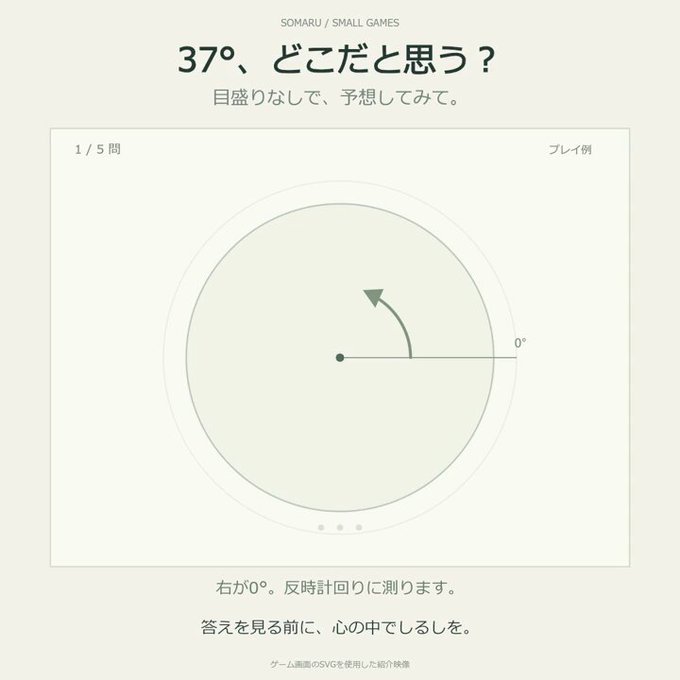
- Right is 0 degrees, up is 90, left is 180, and down is 270; angles increase counterclockwise.
- You play five questions with no time limit, and your score is the total error in degrees across all five.
- Finish all five questions within 5 degrees total error to earn the Human Protractor title.
Quick Facts
| Type | Browser angle-guessing game |
|---|---|
| Devices | Smartphones and desktop browsers |
| Price | Free |
| Languages | English (interface may be minimal) |
| Highlight | Human Protractor title for 5° total error |
| Learning curve | Easy to start, hard to master |
| Category | Browser Games |
| Creator | そまる|ゲーム制作 |
| Official site | angle-sense.somaruru84.chatgpt.site ↗ |
| Heat | 🔥 2.2M Heat |
| Last updated |
What Where Is That Angle? Is and Why It’s Trending
Where Is That Angle? is a free browser game created by Japanese game maker Somaru. The premise is simple: each round shows you a target angle in degrees, and you must mark where that direction falls on a circle that has no protractor markings. You tap or drag to place your marker, then confirm your guess. The game runs directly in your web browser on both smartphones and desktop computers, with no download or installation required.
The game recently started trending because it turns a mundane geometry skill into a quick, shareable challenge. People enjoy comparing their total error and sharing screenshots that show their orange guess marker next to the green correct answer. The quirky goal of earning the Human Protractor title by finishing all five questions within 5 degrees total error gives players a clear target to chase. It is the kind of lightweight, funny game that spreads easily among friends and coworkers.
- Free and instant
No account, download, or payment is needed. Open the page and start guessing angles immediately.
- Mobile-friendly
The game works smoothly on phone browsers, so you can play during a commute or a break.
- Shareable results
After each round, you see your guess and the correct answer side by side, making it easy to screenshot and compare with friends.
How the Angle Guessing Works: Controls, Rules, and Scoring
The game uses a standard mathematical angle system. Right is 0 degrees, and angles increase counterclockwise. That means up is 90 degrees, left is 180 degrees, and down is 270 degrees. Each question gives you a target angle, and you place a marker on the circle by tapping or dragging. Once you confirm, the game reveals the correct angle and your error in degrees. You play five questions in total, and there is no time limit, so you can think carefully before confirming.
Your final score is the sum of the absolute errors from all five questions. Lower is better. The game does not use a traditional points system; instead, it reports your total error in degrees. This makes the challenge easy to understand and compare. If you finish all five questions with a total error of 5 degrees or less, you earn the Human Protractor title. That is a very tight margin, roughly 1 degree per question on average, so it requires both careful estimation and a bit of luck.
- Cardinal directions first
Memorize right = 0°, up = 90°, left = 180°, down = 270°. Use these as anchors for every guess.
- Estimate fractions between anchors
For example, 45° is halfway between right and up. 135° is halfway between up and left. Break the circle into quarters and then eighths.
- No time pressure
Take as long as you need. There is no timer, so you can mentally divide the circle and double-check your marker before confirming.
Tips and Strategies to Improve Your Accuracy
The most effective strategy is to build a mental map of the circle using the four cardinal directions. Before you place your marker, identify which quadrant the target angle falls into. Then estimate how far into that quadrant it sits. For example, 30° is one-third of the way from 0° to 90°, while 60° is two-thirds of the way. Practicing this fraction-based thinking will quickly improve your accuracy.
Another tip is to use the symmetry of the circle. Angles that are multiples of 45° are easy because they fall exactly halfway between cardinal directions. For angles like 37° or 53°, which are common in 3-4-5 triangles, you can remember that 37° is slightly less than 45° and 53° is slightly more. The game’s creator even mentioned 37° in the announcement, hinting that it is a tricky but memorable value. Finally, keep your finger or mouse steady when dragging, and confirm only when you are satisfied with the marker’s position.
- Use the 45° landmarks
Mark the diagonals mentally: 45°, 135°, 225°, 315°. They split each quadrant in half and make estimation easier.
- Remember common angles
30°, 45°, 60°, and 90° are frequent. Also note that 37° and 53° appear in many math problems and are slightly off the 45° diagonal.
- Double-check before confirming
Since there is no timer, take a moment to visually compare your marker’s position with the nearest cardinal direction.
How It Compares to Other Casual Browser Games and Who It’s For
Where Is That Angle? stands out from typical casual browser games because it is purely skill-based and educational without feeling like a lesson. Unlike reaction-based games or endless runners, it rewards calm, deliberate estimation. It is similar in spirit to mental math challenges or quick geography quizzes, but the visual, spatial nature makes it more intuitive and immediately accessible. The lack of a timer also makes it less stressful than many mobile games.
The game is ideal for anyone who enjoys quick brain teasers, math enthusiasts, and people looking for a fun way to sharpen their spatial reasoning. It is also a great conversation starter because the results are easy to share and compare. However, players who crave fast-paced action or complex progression systems may find it too simple. The interface is minimal, and the entire experience lasts only a few minutes per round, which is both a strength and a limitation. Overall, it is a charming, free distraction that delivers exactly what it promises.
- Educational but fun
It teaches angle estimation without feeling like homework, making it suitable for students and adults alike.
- Quick sessions
A full game takes only a few minutes, perfect for a short break or a friendly competition.
- Limited replay value for some
Without levels or unlockables, the game may feel repetitive after several rounds, but the pursuit of the Human Protractor title adds a long-term challenge.
Step-by-Step Guide
Open the game in your browser
Go to angle-sense.somaruru84.chatgpt.site on your smartphone or desktop. The game loads instantly and is free to play. No download or account is required.
Read the target angle
Each round displays a target angle in degrees. Remember that right is 0°, up is 90°, left is 180°, and down is 270°. Use these anchors to plan your guess.
Place your marker
Tap or drag on the circle to position your marker at the estimated angle. You can adjust it as many times as you like before confirming. There is no time limit.
Confirm and see the result
Once you are satisfied, confirm your guess. The game reveals the correct angle and your error in degrees. Your marker turns orange and the correct answer is shown in green.
Complete five questions and check your total
After five questions, the game shows your total error. Aim for 5 degrees or less to earn the Human Protractor title. Share your result with friends for a fun challenge.
Frequently Asked Questions
Is Where Is That Angle? free to play?
Yes, the game is completely free. There are no in-app purchases, ads, or hidden costs. You can play it directly in your browser without downloading anything or creating an account. Just open the official site and start guessing.
Can I play it on my phone?
Yes, the game is designed to work on both smartphones and desktop browsers. The controls are touch-friendly, so you can tap or drag to place your marker. The layout adapts to smaller screens, making it easy to play on the go.
How is the score calculated?
Your score is the total absolute error in degrees across all five questions. For each question, the game calculates the difference between your guessed angle and the correct angle, then sums those differences. Lower totals are better, and a total of 5 degrees or less earns the Human Protractor title.
What is the Human Protractor title?
The Human Protractor is an informal achievement for players who finish all five questions with a total error of 5 degrees or less. It is not a persistent badge or account feature; it is simply a goal to aim for. Achieving it requires very precise estimation, roughly 1 degree per question on average.
Are there any tips for beginners?
Start by memorizing the four cardinal directions: right = 0°, up = 90°, left = 180°, down = 270°. Then estimate angles as fractions between these anchors. For example, 45° is halfway between right and up. Take your time, as there is no timer, and double-check your marker before confirming.