Key Takeaways
- Maya-2 is an open-weight text-to-speech model designed specifically for Indian languages, announced by Dheemanth Reddy on October 14, 2026.
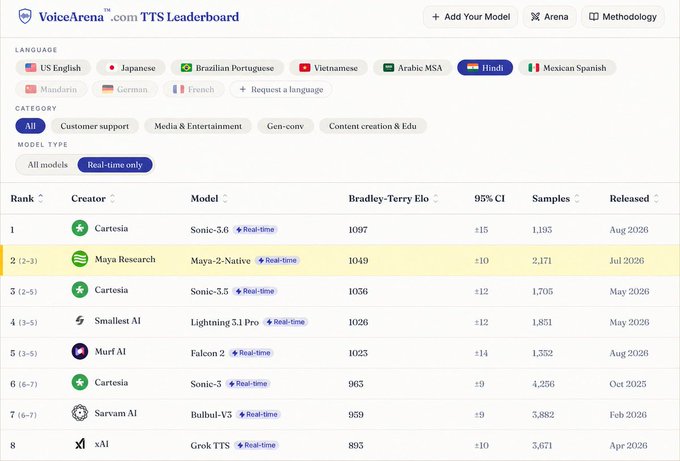
- The creator claims it outperforms ElevenLabs v3, Cartesia Sonic 3.5 and Bulbul v3 across Indian languages, though no independent benchmark data has been published yet.
- It is intended to be completely free for builders, with open weights for download and local deployment, but no public build or official page exists yet.
- You can prepare by testing short phrases in your own language and comparing outputs against commercial TTS models once Maya-2 becomes available.
Quick Facts
| Type | Open-weight text-to-speech AI model |
|---|---|
| Devices | Not confirmed; likely local and cloud deployment |
| Price | Announced as free for builders; not yet live |
| Languages | India's 22 official languages, per creator |
| Highlight | Claimed to beat ElevenLabs v3 on Indic speech |
| Learning curve | Moderate; requires TTS integration knowledge |
| Category | AI & Models |
| Creator | Dheemanth Reddy |
| Heat | 🔥 301.3K Heat |
| Last updated |
What Maya-2 Is and Why It Matters for Indic Speech
Maya-2 is an open-weight voice AI model created by Dheemanth Reddy, announced on October 14, 2026. It is a text-to-speech system built specifically for Indian languages, covering India's 22 official languages. The creator describes it as the world's best Indic voice AI model and positions it as a voice-first solution for a country with over 1.5 billion people. Unlike many speech models that are trained primarily on English data, Maya-2 is tuned for Indic phonetics from the ground up.
The announcement emphasizes that Maya-2 will be fully open-weight, meaning the model parameters will be available for download and local deployment. This is significant for developers and researchers who want to run speech synthesis without relying on proprietary APIs. The creator also states it will be completely free for every builder, though the exact licensing terms have not been published yet. For a region with such linguistic diversity, an open Indic TTS model could lower barriers for building voice applications in local languages.
Maya-2 is claimed to outperform ElevenLabs v3, Cartesia Sonic 3.5 and Bulbul v3 across Indian languages. These are established commercial and open speech models, so the comparison sets a high bar. However, no independent benchmarks, audio samples or technical papers have been released publicly. Until those appear, the performance claims remain unverified. The model's architecture details, training data composition and parameter count are also unknown at this stage.
- Open-weight promise
The model is announced as fully open-weight, which would allow local deployment and fine-tuning. Check the official site for the actual license once it launches.
- Indic-first design
Maya-2 is tuned for Indian phonetics rather than English-first training data. This could produce more natural pronunciation and intonation for languages like Hindi, Tamil or Bengali.
- Competitive claims
The creator says it beats ElevenLabs v3, Cartesia Sonic 3.5 and Bulbul v3 on Indian languages. Independent verification is still pending.
- Free for builders
The announcement says it will be completely free for every builder. The exact pricing and access model have not been confirmed.
How Maya-2 Works Under the Hood and What to Expect
Maya-2 is a text-to-speech model, meaning it takes written text as input and generates spoken audio as output. The creator says its architecture is tuned specifically for Indic phonetics, which suggests the training data and model design prioritize the sound systems of Indian languages. This matters because many multilingual TTS systems treat Indic languages as an afterthought, leading to awkward pronunciation and unnatural rhythm. A phonetics-first approach could deliver more authentic speech for native listeners.
The model is described as open-weight, which typically means the trained parameters are released for anyone to download and run. In practice, open-weight TTS models can be deployed locally on your own hardware or integrated into applications without sending data to a third-party API. This appeals to developers working on privacy-sensitive or offline use cases. However, running such models locally often requires a capable GPU and some technical setup, so the learning curve is moderate.
The announcement mentions that Maya-2 runs smoothly online, but the exact platform or interface has not been detailed. It is possible the model will be available through a web demo, an API, or as a downloadable package. The creator has not published system requirements, inference speed or supported audio formats. Until an official page appears, these operational details remain open questions. Developers should watch for documentation on deployment options and hardware needs.
- Text-to-speech pipeline
Maya-2 converts written text into spoken audio. The quality of the output depends on how well the model handles each language's phonetics and prosody.
- Local deployment potential
Open weights would let you run the model on your own machines. This is useful for offline apps, privacy-sensitive projects or low-latency requirements.
- Hardware considerations
Running TTS models locally usually needs a decent GPU and sufficient memory. Check the official site for specific requirements once published.
- Integration options
The model could be offered as a downloadable package, a web demo or an API. The creator has not confirmed which access methods will be available.
How to Prepare for Maya-2 Before It Launches
Since Maya-2 has no public build or official page yet, you cannot download or test it right now. The creator has only shown it in a short preview video and announcement. The best thing you can do is prepare your evaluation workflow so you are ready when it becomes available. Start by identifying the specific Indian languages you need and collecting short text samples that represent your use case. This will let you quickly compare Maya-2 against your current TTS solution.
While you wait, test existing commercial models like ElevenLabs v3, Cartesia Sonic 3.5 and Bulbul v3 with your sample phrases. Record the outputs and note where pronunciation, intonation or pacing falls short. This gives you a baseline to measure Maya-2 against. You can also explore open-weight TTS models that are already available to understand the typical setup process, including installation, inference and audio export. That experience will be valuable when Maya-2 arrives.
Keep an eye on the creator's official channels for the release announcement. Once Maya-2 is available, start with short phrases in your native language and listen carefully for naturalness. Compare the output side by side with your baseline recordings. If the model supports fine-tuning, try adapting it to your domain-specific vocabulary. Before deploying in production, check the license terms, usage restrictions and any commercial limitations. The official site will be the authoritative source for these details.
- Build a test set
Collect short, representative phrases in each language you care about. Include names, numbers and common expressions to test pronunciation accuracy.
- Benchmark against current tools
Record outputs from ElevenLabs v3, Cartesia Sonic 3.5 and Bulbul v3 now. These become your reference points for judging Maya-2 later.
- Learn open-weight workflows
Try an existing open TTS model to get familiar with installation, inference and audio export. This reduces friction when Maya-2 drops.
- Watch for official documentation
The official site will have license, pricing and system requirements. Do not rely on third-party summaries for these critical details.
How Maya-2 Compares and Who It Is For
Maya-2 enters a growing field of speech synthesis models, but its focus on Indian languages sets it apart. ElevenLabs v3 is a widely used commercial model known for high-quality English and multilingual voices. Cartesia Sonic 3.5 targets low-latency conversational AI. Bulbul v3 is an Indic-focused model from an Indian company. The creator claims Maya-2 outperforms all three on Indian language benchmarks, which would be a significant achievement if verified. However, without public samples or independent tests, these claims should be treated as promotional for now.
The open-weight nature of Maya-2 is its biggest differentiator. Commercial models like ElevenLabs typically require API calls and usage fees, while open-weight models can be self-hosted and customized. For developers building voice applications for Indian users, this could mean lower costs and greater control. It also enables offline functionality, which is important in regions with unreliable internet. The trade-off is that self-hosting requires technical expertise and hardware investment.
Maya-2 is aimed at builders, researchers and companies working with Indian languages. If you are developing a voice assistant, an audiobook platform, a customer service bot or an accessibility tool for Indic speakers, this model could be relevant. It is less suited for those who need a plug-and-play solution with no setup. The learning curve is moderate, and the lack of an official release means you cannot evaluate it yet. Keep an eye on the official site for updates and be ready to test it when it launches.
- Versus ElevenLabs v3
ElevenLabs v3 is a polished commercial model with broad language support. Maya-2 claims better Indic performance but is not yet available for comparison.
- Versus Cartesia Sonic 3.5
Cartesia focuses on low-latency streaming for real-time applications. Maya-2's open weights could offer more flexibility for custom deployments.
- Versus Bulbul v3
Bulbul v3 is another Indic-focused model. Maya-2's claimed advantage is open weights and free access for builders, pending confirmation.
- Who should care
Developers, researchers and product teams building voice experiences for Indian languages. Not ideal for those needing an immediate, no-setup solution.
Step-by-Step Guide
Confirm availability status
As of now, Maya-2 has no public build, download or official page. The creator has only shown a short preview. Check the official site and the creator's announcements for the actual release before planning any integration.
Prepare your language test set
Collect short text samples in the Indian languages you need. Include everyday phrases, names, numbers and domain-specific terms. This will let you quickly evaluate Maya-2's pronunciation and naturalness once it is available.
Benchmark current TTS options
Record outputs from ElevenLabs v3, Cartesia Sonic 3.5 and Bulbul v3 using your test set. Note strengths and weaknesses in pronunciation, intonation and pacing. These recordings become your baseline for comparison.
Set up an open-weight testing environment
If you plan to self-host, prepare a machine with a capable GPU and install a framework for running TTS models. Familiarize yourself with loading models, generating audio and exporting files. This reduces setup time when Maya-2 arrives.
Evaluate and iterate
Once Maya-2 is released, generate audio for your test set and compare it side by side with your baseline. Listen for naturalness, accuracy and consistency. If fine-tuning is supported, adapt the model to your specific vocabulary and style.
Frequently Asked Questions
Is Maya-2 available to download or use right now?
No. As of the announcement, there is no public build, download or official page for Maya-2. The creator has only shown it in a short preview video. You cannot test or deploy it yet. Check the official site for updates on when it will be released.
What languages does Maya-2 support?
The creator states it covers India's 22 official languages. These include Hindi, Bengali, Telugu, Marathi, Tamil, Urdu, Gujarati, Kannada, Malayalam, Odia, Punjabi and others. The exact level of support per language has not been detailed. Check the official site for a full language list when it launches.
Will Maya-2 really be free?
The announcement says it will be completely free for every builder. However, the exact licensing terms and any commercial restrictions have not been published. Open-weight models sometimes have conditions for commercial use. Check the official site for the final license before relying on it for production.
How does Maya-2 compare to ElevenLabs v3?
The creator claims Maya-2 outperforms ElevenLabs v3 across Indian languages. ElevenLabs v3 is a mature commercial model with strong multilingual support. However, no independent benchmarks or audio samples for Maya-2 have been released. Treat the comparison as a claim until verified by your own testing.
What hardware will I need to run Maya-2 locally?
System requirements have not been announced. Open-weight TTS models typically need a GPU with sufficient memory for real-time inference. The exact specifications depend on the model size and optimization. Check the official site for recommended hardware once documentation is available.