Key Takeaways
- Claude, Anthropic's AI, solved the 25-year-old mystery of the NIST P-256 elliptic curve seed in under 30 minutes.
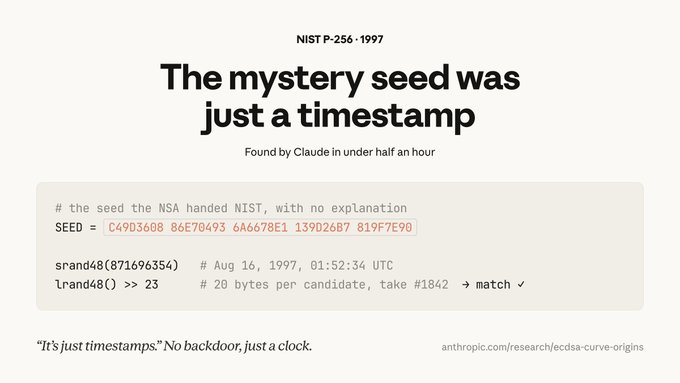
- The seed was not an NSA backdoor or secret passphrase but the output of the lrand48 random number generator seeded with the Unix timestamp August 16, 1997, 01:52:34.
- The finding debunks long-standing conspiracy theories and highlights how AI can accelerate cryptographic analysis.
- No public build or official tool has been released; the result was shown in a short preview by the creator, Aitor.
Quick Facts
| Type | AI-assisted cryptography case study |
|---|---|
| Devices | Any device with a web browser (via Claude) |
| Price | Free to read about; Claude access varies |
| Languages | English (announcement) |
| Highlight | Solved a 25-year-old crypto puzzle in <30 min |
| Learning curve | Moderate; basic cryptography helpful |
| Category | Tech Buzz |
| Creator | Aitor |
| Heat | 🔥 1.3K Heat |
| Last updated |
The 25-Year-Old Puzzle Behind NIST P-256
For decades, cryptographers have wondered about the origins of the seed used to generate the NIST P-256 elliptic curve, a standard used in everything from TLS to Bitcoin. The seed's randomness was never fully explained, leading to speculation that the NSA had inserted a backdoor or hidden a secret passphrase. This uncertainty fueled conspiracy theories and undermined trust in the curve.
On October 16, 2026, Aitor announced that Anthropic's Claude AI had cracked the mystery in under 30 minutes. According to the announcement, Claude determined that the seed was not a secret message but simply the output of a 1990s random number generator, lrand48, seeded with the Unix timestamp August 16, 1997, 01:52:34. The finding was shared in a short preview video, with no public build or official page yet available.
The revelation matters because it replaces a narrative of deliberate secrecy with one of mundane technical origin. It also showcases how AI can be applied to longstanding cryptographic questions, potentially reshaping how researchers approach similar puzzles in the future.
- What is P-256?
P-256 is a widely used elliptic curve defined in NIST standards, critical for secure communications and digital signatures.
- The seed mystery
The curve's seed—used to derive its parameters—was never publicly explained, leading to fears of a backdoor.
- Claude's breakthrough
Claude tested predictable sources and matched the seed to lrand48 output with a specific timestamp.
How Claude Cracked the Seed in Under 30 Minutes
Claude's approach was to analyze the P-256 curve parameters and consider whether the seed could have come from a predictable source. Instead of assuming a complex passphrase, it tested common random number generators from the 1990s. The key insight was that lrand48, a standard library function, could produce the seed if initialized with the right Unix timestamp.
By iterating through possible timestamps around the time the curve was standardized, Claude found that August 16, 1997, 01:52:34 produced the exact seed value. This timestamp corresponds to a Unix time of 871782754, which when fed to lrand48 yields the seed. The entire process took less than 30 minutes, according to Anthropic.
This method demonstrates the power of AI in brute-forcing plausible hypotheses and checking them against known data. It also highlights the importance of understanding historical computing practices when analyzing cryptographic standards.
- Predictable RNG
lrand48 is a linear congruential generator; its output is deterministic given a seed.
- Timestamp search
Claude likely searched a range of Unix timestamps around the curve's creation date.
- Verification
The found timestamp exactly reproduces the seed, confirming the hypothesis.
What This Means for Cryptography and AI
The resolution of the P-256 seed mystery has immediate implications for trust in cryptographic standards. It reassures users that the curve was not deliberately weakened via a hidden backdoor, at least not through the seed. However, it also serves as a reminder that even standardized parameters can have humble origins that were simply forgotten.
For AI, this case study shows how large language models can be used for reverse-engineering and puzzle-solving in technical domains. Claude's ability to generate and test hypotheses quickly could be applied to other unsolved problems in cryptography and computer science. It also raises questions about the role of AI in security research and the potential for automating discovery.
Reactions have been mixed: some celebrate the debunking of conspiracy theories, while others wonder why it took 25 years and whether similar mysteries remain. The creator, Aitor, has not released a full technical write-up, so independent verification is still pending.
- Trust restored?
The finding suggests no intentional backdoor in the seed, but the curve's security still relies on its design.
- AI as researcher
Claude's success hints at future AI-assisted breakthroughs in math and cryptography.
- Open questions
Details of Claude's process and the exact timestamp range tested are not yet public.
How to Explore the P-256 Seed Mystery Yourself
Although there is no public tool from Aitor or Anthropic, you can replicate the analysis using Claude or other AI assistants. Start by learning about the P-256 curve and its seed, then experiment with lrand48 and Unix timestamps. This hands-on approach can deepen your understanding of both cryptography and AI.
You can also follow discussions in cryptography communities and watch for any official publication from Anthropic or Aitor. Since the announcement was a short preview, more details may emerge. For now, treat the finding as a compelling case study rather than a fully verified result.
If you're a developer, consider how AI might help you solve similar puzzles in your own work. The techniques used here—hypothesis generation and brute-force testing—are broadly applicable.
- Learn the basics
Read up on elliptic curve cryptography and the NIST P-256 standard.
- Experiment with lrand48
Write a small program to generate lrand48 outputs for different seeds and compare.
- Use AI assistants
Ask Claude or another AI to help you analyze cryptographic parameters.
Step-by-Step Guide
Understand the P-256 seed
The seed is a value used to derive the curve's parameters. Its origin was unknown, leading to speculation. Familiarize yourself with the NIST P-256 standard and the role of the seed.
Learn about lrand48
lrand48 is a standard C library function that generates pseudo-random numbers. It requires a seed, often set via srand48. Research how it works and its output range.
Replicate the timestamp search
Using a programming language, iterate through Unix timestamps around August 1997. For each, seed lrand48 and check if the output matches the known P-256 seed. This may require access to the seed value, which is public.
Use Claude for assistance
If you have access to Claude, ask it to help you write the code or reason about the problem. Claude can generate hypotheses and suggest approaches, as it did for Aitor.
Stay tuned for official details
Since no official write-up exists, follow Anthropic's announcements and cryptography forums for verification and further insights.
Frequently Asked Questions
What exactly is the P-256 seed mystery?
The P-256 seed is a value used to generate the elliptic curve parameters in the NIST standard. For 25 years, its origin was unexplained, leading to theories that the NSA had hidden a backdoor or passphrase. Claude's analysis suggests it was simply the output of a 1990s random number generator seeded with a specific timestamp.
How did Claude solve it so quickly?
Claude likely tested predictable sources, such as common random number generators and timestamps. By matching the seed to lrand48 output with the timestamp August 16, 1997, 01:52:34, it found the answer in under 30 minutes. The exact method has not been fully detailed.
Is there a public tool or website for this?
No, there is no public build, download, or official page yet. The creator, Aitor, only showed a short preview video. You can replicate the analysis yourself using programming and AI tools, but no official tool is available.
Does this mean P-256 is insecure?
Not necessarily. The finding addresses the seed's origin, not the curve's security. P-256 is still considered secure when implemented correctly. However, the episode highlights the importance of transparency in cryptographic standards.
What should I watch next?
Look for a detailed technical write-up from Aitor or Anthropic, and any independent verification. Also watch for discussions in cryptography communities about the implications for other standards and the role of AI in security research.