Key Takeaways
- Futari no Egogram is a free web app created by Hanamaru that runs in any modern browser on phones and desktops.
- You answer 25 yes/no/neutral questions in about three minutes to get a five-letter code representing five ego states: CP, NP, A, FC, and AC.
- For compatibility, you enter two names and their codes, and the site explains how the two personalities interact.
- It is designed for fun and self-reflection, not as a scientific or clinical assessment.
Quick Facts
| Type | Personality and compatibility quiz |
|---|---|
| Devices | Any modern browser on phone or desktop |
| Price | Free |
| Languages | Japanese (check official site for others) |
| Highlight | Detailed compatibility explanation |
| Learning curve | Very easy; about 3 minutes |
| Category | Entertainment |
| Creator | はなまる |
| Official site | kaimin.sakura.ne.jp ↗ |
| Heat | 🔥 652 Heat |
| Last updated |
What Futari no Egogram Is and Why It's Trending
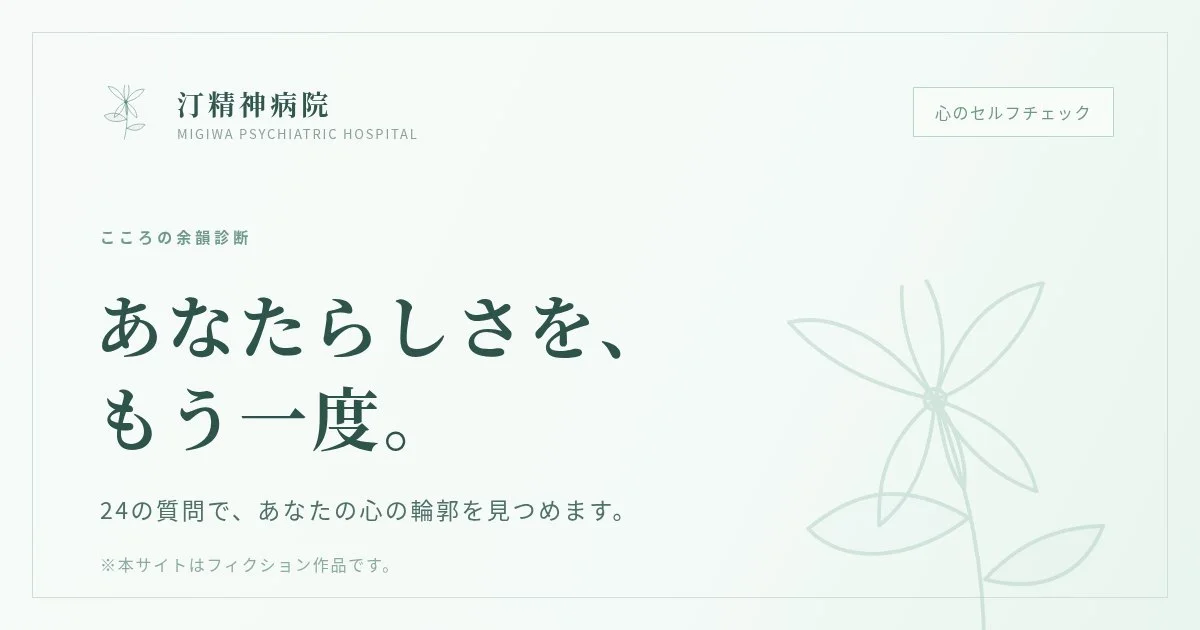
Futari no Egogram (roughly 'the two-person egogram') is a free browser-based personality and compatibility quiz created by Hanamaru. It launched in October 2026 and quickly found an audience in Japan, especially among people who enjoy pairing fictional characters or testing friendships. The core idea is simple: answer 25 questions, get a five-letter code, and then compare that code with someone else's to see how your personalities might interact.
The quiz is built on the egogram concept, a popular self-assessment tool in Japan that maps five ego states: Critical Parent (CP), Nurturing Parent (NP), Adult (A), Free Child (FC), and Adapted Child (AC). Each state gets a letter grade from A to D, and the combination forms your personal code. Unlike a full clinical egogram, this version is streamlined for quick, casual use and is explicitly meant for entertainment rather than diagnosis.
What sets Futari no Egogram apart is its compatibility mode. Instead of just giving you a static result, it lets you enter two names and two codes and then generates a written explanation of how those two personalities might get along. That feature has made it a popular tool for fans who want to explore character dynamics, as well as for friends and couples looking for a lighthearted conversation starter.
- Five ego states, five letters
Your result is a five-letter code, one letter per ego state, each rated from A to D. The pattern gives a quick snapshot of which states dominate your personality.
- Compatibility made easy
You can compare any two codes, not just your own. That means you can test fictional pairings or see how you match with multiple friends.
- Optional adult section
The creator notes there is an optional adult-oriented section that is not intended for minors. You can skip it entirely if you are under 18.
How the 25-Question Test Works, Step by Step
When you start the quiz, you are asked 25 questions about your typical thoughts, feelings, and behaviors. Each question offers three choices: yes, no, or neutral. There is no time limit, and you can change your answers before submitting. The quiz is designed to take about three minutes, so it fits easily into a break or a commute.
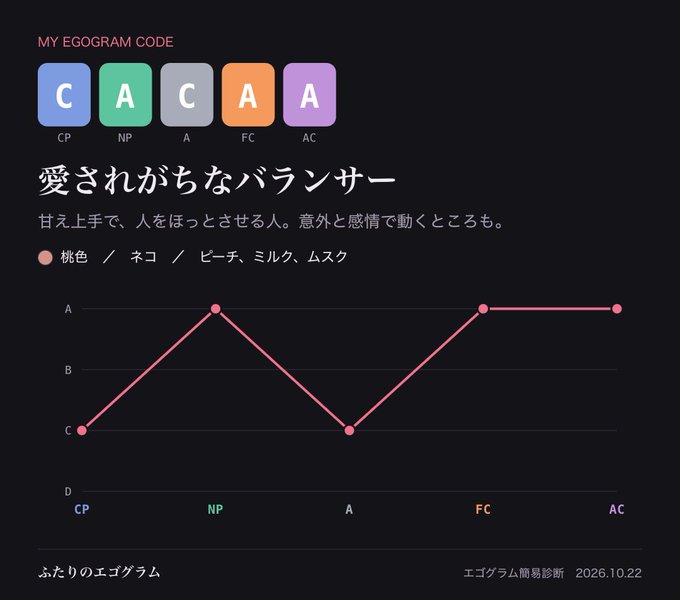
After you finish, the site calculates your score for each of the five ego states. Each state receives a letter grade from A to D, where A typically means that state is strongly present and D means it is less pronounced. The exact scoring algorithm is not published, but the result is presented as a five-letter code, such as CACAA. The creator's own result was CACAA, which the site described as 'a balancer who tends to be loved.'
You can optionally enter a nickname before or after the test. That name is used to label your result and can make sharing easier. The quiz does not require an account, and your answers are not stored on a server according to the site's design; everything runs in your browser. For the compatibility reading, you will need the codes of both people, so it is best to take the test first and then share your code.
- Answer honestly and quickly
The quiz works best when you go with your first instinct. Overthinking can skew your results toward what you think you should be rather than what you are.
- Use the neutral option sparingly
Neutral answers are useful when a question truly does not apply, but too many can blur the distinction between ego states.
- Take it more than once
Your mood or recent experiences can influence answers. Taking the quiz on different days can reveal which traits are stable and which are situational.
Reading Your Five-Letter Code and Compatibility Results
Your five-letter code is read in the order CP, NP, A, FC, AC. Each letter tells you how strongly that ego state shows up in your personality. For example, a high CP might mean you are principled and critical, while a high NP suggests you are nurturing and supportive. A high A indicates a logical, analytical side, FC reflects spontaneity and playfulness, and AC shows adaptability and compliance.
The compatibility reading compares two codes and explains how the two personalities might interact. It does not simply say 'good' or 'bad'; instead, it describes potential synergies and friction points. For instance, two people with high CP might clash over who is right, while a high NP paired with a high FC could balance care with fun. The explanation is written in plain language and is meant to spark conversation rather than provide a verdict.
It is important to remember that the results are not a scientific assessment. The egogram is a popular psychology tool, and this quiz is a lighthearted take on it. Use the results as a starting point for reflection or as a fun activity with friends, but do not treat them as definitive labels. The site itself emphasizes that it is for entertainment.
- CP: Critical Parent
High CP suggests a strong sense of right and wrong, discipline, and leadership. Low CP might mean you are more permissive or flexible.
- NP: Nurturing Parent
High NP indicates warmth, empathy, and a tendency to care for others. Low NP might mean you are more self-focused or independent.
- A: Adult
High A reflects logic, problem-solving, and objectivity. Low A might mean you rely more on intuition or emotion.
- FC: Free Child
High FC is associated with spontaneity, creativity, and joy. Low FC might mean you are more reserved or serious.
How It Compares to Other Personality Quizzes and Who It's For
Futari no Egogram is not the only personality quiz out there, but its focus on compatibility sets it apart. Most quizzes give you a single result and stop there. This one encourages you to bring in another person, which makes it inherently social. That social element is likely why it has spread among fans who enjoy imagining how fictional characters would interact, as well as among friends looking for a shared activity.
Compared to longer assessments like the MBTI or the Big Five, this quiz is much shorter and less granular. It does not aim to capture the full complexity of personality; instead, it offers a quick, digestible snapshot. The five-letter code is easy to remember and share, which is part of its appeal. However, the trade-off is that it may not capture nuance or change over time as well as more detailed tests.
The quiz is best suited for adults and older teens who understand that it is a game. The optional adult section is clearly marked and can be skipped. Because it runs in a browser, it works on smartphones and desktops without any installation. If you enjoy personality quizzes, fan culture, or simply want a fun way to break the ice, Futari no Egogram is worth a try. Just keep your expectations light and enjoy the conversation it sparks.
- Social by design
The compatibility mode turns a solo quiz into a shared experience, making it ideal for friends, couples, or fan communities.
- Quick and accessible
At 25 questions and about three minutes, it is far shorter than most personality tests, and it requires no sign-up.
- Not a clinical tool
The results are for entertainment and self-reflection, not for psychological diagnosis or major life decisions.
Step-by-Step Guide
Open the quiz in your browser
Go to the official site at kaimin.sakura.ne.jp on your phone or computer. The quiz loads directly in the browser with no download or account needed.
Answer the 25 questions
Read each question and choose yes, no, or neutral based on your typical behavior. There is no time limit, so take a moment to consider each one honestly.
Get your five-letter code
After the last question, the site calculates your result and displays your five-letter code. You can optionally add a nickname to personalize the result.
Share your code and compare
Give your code to a friend or enter two codes in the compatibility section. The site will generate a written explanation of how your personalities interact.
Reflect and have fun
Read the compatibility description with an open mind. Use it as a conversation starter, not as a definitive judgment, and remember it is meant for entertainment.
Frequently Asked Questions
Is Futari no Egogram free to use?
Yes, the quiz is completely free and runs in your browser. There is no charge to take the test or to use the compatibility feature. You do not need to create an account or provide payment information. Just visit the official site and start answering questions.
How long does the quiz take?
Most people finish the 25 questions in about three minutes. The quiz is designed to be quick and intuitive, so you can complete it during a short break. There is no timer, so you can take as long as you like, but going with your first instinct usually gives the most natural result.
Can I use it on my phone?
Yes, Futari no Egogram is optimized for mobile browsers. It works on both iOS and Android devices, as well as on desktop computers. You do not need to download an app; simply open the site in your phone's browser and the quiz will adjust to your screen.
What do the letters in the code mean?
The five letters correspond to five ego states: CP (Critical Parent), NP (Nurturing Parent), A (Adult), FC (Free Child), and AC (Adapted Child). Each letter is a grade from A to D that indicates how strongly that state is present in your personality. The combination gives a quick overview of your tendencies.
Is the result scientifically accurate?
No, the quiz is intended for entertainment and self-reflection, not as a scientific or clinical assessment. The egogram concept is a popular psychology tool, but this version is simplified and should not be used for diagnosis or major decisions. Enjoy it as a fun activity and a way to spark conversation.