Key Takeaways
- 1 in 8 Billion is a free browser-based life simulation created by KAI-YOU that assigns you a random life based on real-world statistics from 141 countries.
- You don't make choices: the game determines your country, parents, economic situation and eventual cause of death, then presents the life as a short narrative.
- It runs on both desktop and smartphone browsers at 1in8b.life, with no download required.
- The experience is quick and shareable, making it a popular casual game for a few minutes of reflection.
Quick Facts
| Type | Life simulation browser game |
|---|---|
| Devices | Desktop and smartphone browsers |
| Price | Free |
| Languages | Check official site |
| Highlight | Uses UN, WHO, World Bank data across 141 countries |
| Learning curve | None; one tap to start |
| Category | Browser Games |
| Creator | KAI-YOU(カイユウ) |
| Official site | 1in8b.life ↗ |
| Heat | 🔥 1.3M Heat |
| Last updated |
What 1 in 8 Billion Actually Simulates
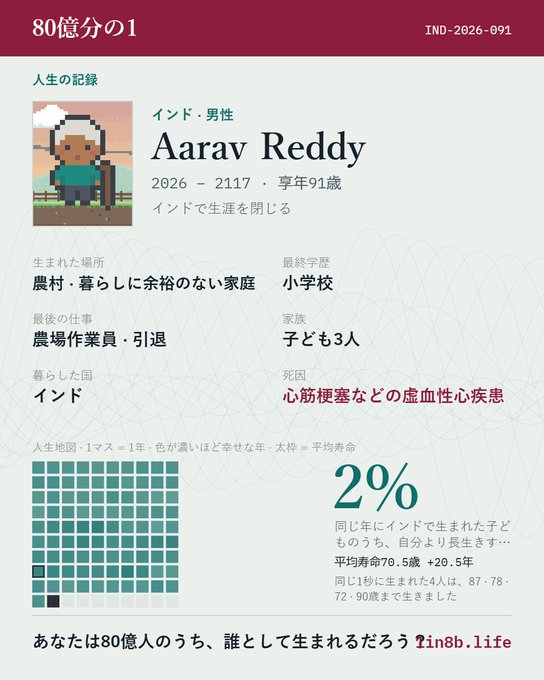
1 in 8 Billion is a browser game built by the Japanese media company KAI-YOU. The title refers to you as one person among roughly eight billion on Earth. Instead of letting you create a character, the game randomly assigns your country of birth, your parents and your family's economic standing, then walks you through a life story shaped by those starting conditions. It is less a game of choices and more a statistical mirror held up to chance.
The simulation draws on published statistics from the United Nations, the World Health Organization, the World Bank and other international bodies, covering 141 countries. That means the likelihood of being born in a particular place, the kind of work you might do, and even the cause of death you receive are informed by real-world data rather than pure fiction. The result is a short, readable life summary that feels both personal and grounded in reality.
- No character creation
You don't pick your gender, nationality or family background. The game rolls them for you, reinforcing the theme that no one chooses where they start.
- Real statistical backbone
Birthplace probabilities and life outcomes are modeled on data from the UN, WHO and World Bank, so the experience reflects actual global inequalities.
- Narrative, not a score
There is no winning or losing. The payoff is the story you receive, which you can read in under a minute and then share.
How the Life Lottery Works, Step by Step
When you open the game, you are presented with a simple interface and a single prompt to begin. Tapping or clicking starts the simulation. The game then randomly selects a country from its 141-country dataset, weighted by population statistics, and assigns you a family situation. From there, it generates a sequence of life events: childhood, education, career, relationships and eventually death. Each event is described in a sentence or two, forming a compact biography.
The experience is entirely passive. You don't make choices or solve puzzles; you simply read what happens. This makes it accessible to anyone, regardless of gaming experience. The whole run takes only a few minutes, and you can replay immediately to see a different life. Because the outcomes are statistically driven, some lives will be comfortable and long, while others will be brief and harsh, mirroring the real distribution of fortune around the world.
- One-tap start
There is no setup screen or tutorial. A single tap begins the simulation, making it ideal for a quick break.
- Weighted randomness
Countries are not equally likely; the game uses population data so you are more likely to be born in populous nations, just as in reality.
- Replayability
Each run produces a new life, so you can compare outcomes and see how birthplace shapes destiny.
Tips for Getting More Out of Each Run
Because 1 in 8 Billion is not a skill-based game, there are no strategies to improve your score. However, you can enhance the experience by paying attention to the details. Note the country, the family's economic status and the cause of death. These elements are directly tied to the statistical model, so they offer a window into global health and inequality. Playing with friends and comparing lives can spark interesting conversations about privilege and chance.
If you want to explore specific regions, you can simply replay until you get a country you're curious about, but be aware that the randomness is weighted by population, so some countries will appear more often than others. The game is best enjoyed in short sessions, perhaps as a daily ritual. Since it runs in the browser, you can play on a phone during a commute or on a desktop during a break. There is no save function, so each session is self-contained.
- Read the context
The game's power comes from the juxtaposition of mundane details and statistical reality. Take a moment to reflect on what each life implies.
- Compare with friends
Sharing your life story and hearing others' can lead to meaningful discussions about global inequality and random chance.
- Play on mobile
The game is designed to work on smartphone browsers, so you can easily play while waiting in line or on public transport.
How It Compares to Other Casual Web Games
Most casual browser games rely on skill, reflexes or puzzle-solving, like 2048 or Wordle. 1 in 8 Billion stands apart by offering no interaction beyond starting the simulation. Its closest relatives are text-based life simulators like BitLife, but unlike those, it removes all agency. This makes it more of an interactive thought experiment than a traditional game. The lack of choices is the point: it forces you to confront the randomness of birth.
The game's use of real-world data also distinguishes it from purely fictional simulators. By grounding outcomes in statistics from reputable organizations, it carries an educational weight. That said, it is not a comprehensive tool for understanding global demographics; it is a simplified model. The game is best for a quick, thought-provoking diversion rather than deep analysis. Its free availability and mobile compatibility make it easy to try, and its short length encourages repeat plays.
- No skill required
Unlike reaction-based or puzzle games, 1 in 8 Billion is about reading and reflecting, not winning.
- Educational angle
The statistical basis gives it a documentary feel, setting it apart from purely fictional life sims.
- Quick and shareable
Each run is short enough to fit into a break, and the resulting story is easy to share with others.
Step-by-Step Guide
Open the game in your browser
Go to 1in8b.life on any device with a modern browser. There is no download or installation required. The game loads directly in the page.
Start the simulation
Tap or click the start button to begin. The game will immediately assign you a random life based on its statistical model. No input is needed beyond this initial action.
Read your life story
The game presents a series of short sentences describing your birth, family, education, career, relationships and death. Pay attention to the country and cause of death, as these are tied to real-world data.
Replay for a new life
If you want to see another outcome, simply start again. Each run is independent and takes only a minute or two. You can repeat as many times as you like.
Frequently Asked Questions
Is 1 in 8 Billion really free?
Yes, the game is free to play. There is no cost to access it on the official site, 1in8b.life. As with many free browser games, it may be supported by ads or other revenue models, so check the site for details. No payment is required to experience the core simulation.
Can I play it on my phone?
Yes, 1 in 8 Billion is designed to work on smartphone browsers as well as desktop computers. You don't need to install an app; just open the site in your mobile browser. The interface is simple and should adapt to smaller screens.
How does the game decide my life?
The game uses statistical data from sources like the United Nations, WHO and World Bank across 141 countries. It randomly selects a country weighted by population, then assigns family circumstances and life events based on probabilities derived from that data. You don't make any choices; the outcome is entirely determined by the model.
Is there a way to win or get a better life?
No, there is no winning or losing. The game is a simulation, not a competition. Some lives will be more fortunate than others purely by chance. The purpose is to reflect on the randomness of birth and the inequalities that exist in the world, not to achieve a high score.
Who created 1 in 8 Billion?
The game was created by KAI-YOU, a Japanese media company. It was announced on October 13, 2026, and quickly gained attention for its thought-provoking premise. KAI-YOU is known for its coverage of internet culture and creative projects.