The short version
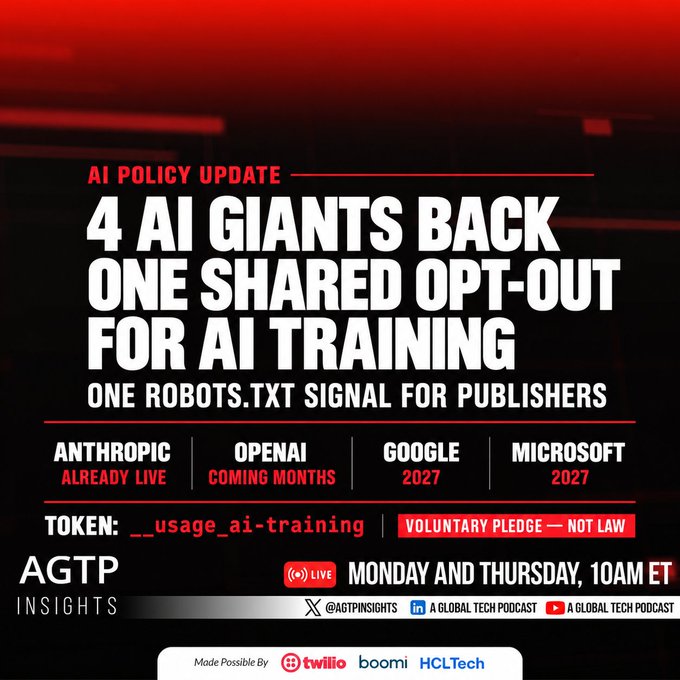
- OpenAI, Google, Microsoft, and Anthropic Back One Unified robots.txt Training Opt-Out (Endorsing Companies: OpenAI, Google, Microsoft, and Anthropic; Protocol File: Root robots.txt unified signaling directive).
- Decoupling Foundation-Model Training Scraping From Live AI Search Retrieval (Core Mechanism: Blocks bulk model training while preserving AI search citations).
- How Publishers Can Block Dataset Ingestion Without Losing Search Referral Traffic (Problem Solved: Eliminates maintaining dozens of fragmented bot user-agents).
At a glance
| Endorsing Companies | OpenAI, Google, Microsoft, and Anthropic |
|---|---|
| Protocol File | Root robots.txt unified signaling directive |
| Core Mechanism | Blocks bulk model training while preserving AI search citations |
| Problem Solved | Eliminates maintaining dozens of fragmented bot user-agents |
| Category | Tech News |
| Creator / publisher | AGTP |
| Source link | openai.com ↗ |
| Heat | 🔥 261 Heat |
| Announced | |
| Data updated |
OpenAI, Google, Microsoft, and Anthropic Back One Unified robots.txt Training Opt-Out
OpenAI, Google, Microsoft, and Anthropic jointly endorsed a unified robots.txt signaling standard that lets website operators block foundation-model training crawlers with a single rule while keeping their pages visible in AI search and live citations.
Decoupling Foundation-Model Training Scraping From Live AI Search Retrieval
Previously, publishers had to maintain dozens of vendor-specific bot user-agents and risked accidentally blocking search indexing bots when trying to opt out of dataset scraping. The unified directive separates training ingestion from search retrieval.
How Publishers Can Block Dataset Ingestion Without Losing Search Referral Traffic
Site owners who rely on organic search and AI citation traffic can now update their root robots.txt file to opt out of bulk training runs without sacrificing referral clicks from answer engines.
FAQ
What are the verified facts and timeline behind Unified robots.txt AI Training Opt-Out Standard?
Endorsing Companies: OpenAI, Google, Microsoft, and Anthropic; Protocol File: Root robots.txt unified signaling directive; Core Mechanism: Blocks bulk model training while preserving AI search citations. Previously, publishers had to maintain dozens of vendor-specific bot user-agents and risked accidentally blocking search indexing bots when trying to opt out of dataset scraping.
What are the key implications and what happens next?
Problem Solved: Eliminates maintaining dozens of fragmented bot user-agents. Site owners who rely on organic search and AI citation traffic can now update their root robots.txt file to opt out of bulk training runs without sacrificing referral clicks from answer engines.