Key Takeaways
- Ming-3.0 is a five-model speech family from Ant Group's inclusionAI, released under the MIT license, so commercial and personal use is broadly permitted.
- The 0.5B TTS model handles voice design, voice cloning and paralinguistic cues like laughter and sighs; larger variants cover long-form speech, audio understanding and dialect ASR.
- Models run through official inference code and vLLM, which supported them on day one, and weights are hosted on Hugging Face.
- The 0.5B TTS reportedly tops the open-source controllable speech leaderboard on Artificial Analysis at 1069 Elo, though you should verify current rankings yourself.
Quick Facts
| Type | Open-source speech model family (TTS, audio, ASR) |
|---|---|
| Devices | GPU servers; small models may run on consumer GPUs |
| Price | Free under MIT license; check official site |
| Languages | Multilingual; check model cards for exact coverage |
| Highlight | 0.5B TTS with voice design and paralinguistic cues |
| Learning curve | Moderate; Python and GPU setup helpful |
| Category | AI & Models |
| Creator | Ant Ling |
| Official site | huggingface.co ↗ |
| Heat | 🔥 1M Heat |
| Last updated |
What Ming-3.0 Actually Is and Who Built It
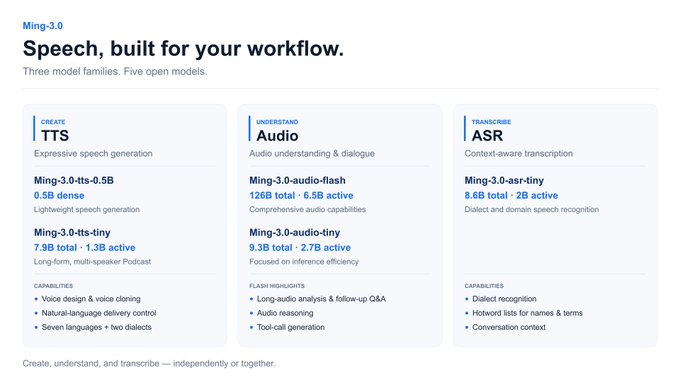
Ming-3.0 is a family of five speech models announced on October 19, 2026 by Ant Group's inclusionAI team. The family is split across three speech areas: text-to-speech, audio understanding and speech recognition. All five models are open-sourced under the MIT license, which is unusually permissive for a release of this size and means you can use them in commercial products without paying a licensing fee.
The five models are Ming-3.0-tts (0.5B) for voice design and paralinguistic cues, Ming-3.0-tts Tiny (7.9B total, 1.3B active) for long-form speech, Ming-3.0-audio Flash (126B total, 6.5B active) for understanding and tools, Ming-3.0-audio Tiny (9.3B total, 2.7B active) for efficient dialogue, and Ming-3.0-asr Tiny (8.6B total, 2B active) for dialects and context-aware recognition.
The naming convention tells you something useful: the number before the A is total parameters, and the number after is active parameters. That means the larger models are mixture-of-experts designs that only activate a fraction of their weights per token, keeping inference costs far below what the raw parameter count suggests. The 0.5B TTS model is a dense model and is the smallest and easiest entry point.
- MIT license across the board
All five models ship under MIT, so you can fine-tune, redistribute and commercialize them. Always read the model card for any additional notes.
- Three families, five models
TTS covers voice creation and long-form reading, audio covers understanding and dialogue, and ASR covers dialect and context-aware transcription.
- Active-parameter design
The larger models use sparse activation, so a 126B model runs with only 6.5B active parameters per token, which cuts serving cost dramatically.
- Day-one vLLM support
vLLM supported the models from launch, which means you can serve them with a familiar high-throughput inference stack instead of writing custom code.
Voice Design, Cloning and Paralinguistic Cues in the 0.5B TTS
The headline act is the 0.5B TTS model, and its party trick is voice design. Instead of cloning an existing speaker, you describe the voice you want in text and the model generates it. That opens up workflows where you need a consistent narrator, a character voice or a brand voice that does not belong to any real person, which sidesteps a lot of consent and likeness problems.
It also clones voices from reference audio and adds paralinguistic cues such as laughter and sighs. Those small non-verbal sounds are what make synthetic speech feel human rather than robotic, and they are usually the first thing missing from cheaper TTS systems. Being able to trigger them from text means you can script emotional beats directly into your input.
The model is small enough that latency and cost stay reasonable, which matters if you are generating speech in a live product rather than batch-rendering files. Community discussion reports that it tops the open-source controllable speech leaderboard on Artificial Analysis at 1069 Elo. Treat that number as a snapshot, not a permanent fact, and check the current leaderboard before you quote it.
- Text-described voices
Describe tone, age, pace or character in plain language and the model builds a matching voice without any reference recording.
- Cloning from reference audio
Provide a sample and the model imitates it. Only clone voices you have permission to use, and check local rules on voice likeness.
- Laughter, sighs and other cues
Non-verbal sounds can be prompted alongside speech, which makes dialogue and narration sound far less flat.
- Leaderboard position
The reported 1069 Elo on Artificial Analysis is a strong signal, but rankings shift as new models appear, so verify before citing it.
Running Ming-3.0: Setup, Inference and Practical Workflow
Start on Hugging Face, where the weights and model cards live. The creator's official site is huggingface.co, and there is no dedicated product page for the Ming-3.0 family yet, so the model cards are your primary documentation. Read the card for the specific model you want before downloading anything, because the five models have different requirements and different intended jobs.
For serving, you have two main routes. The official inference code gives you a reference implementation that matches the paper and the card, which is the safest way to reproduce reported behavior. vLLM supported the models on day one, so if you already run vLLM you can load them into your existing stack and get batching and throughput benefits without writing a new server.
A sensible first test is short sentences that stress the model in specific ways: names, numbers, punctuation and mixed-language text. These are where TTS systems usually stumble, and a five-minute test tells you more than any leaderboard. Once short inputs sound right, move to long-form passages with the Tiny 7.9B A1.3B variant, which is built for extended speech rather than one-liners.
- Read the model card first
Each of the five models has its own card covering inputs, outputs and limits. Skipping it is the most common source of wasted setup time.
- Pick your serving path
Use official inference code for fidelity or vLLM for throughput. Both are supported, so choose based on whether you are validating or shipping.
- Stress-test with hard text
Names, numbers, punctuation and code-switching expose weaknesses fast. Test these before you commit to a full production workflow.
- Match model to task
Use the 0.5B for voice design, the Tiny long-form model for narration, and the audio or ASR models for understanding and transcription.
How Ming-3.0 Compares and Where It Falls Short
The obvious comparison is with other open speech stacks. Many open TTS projects give you cloning or give you a fixed set of voices, but few combine cloning, text-described voice design and paralinguistic cues in a single small model under a permissive license. The MIT terms are a real differentiator, because some competing releases restrict commercial use or add usage policies that complicate deployment.
The audio understanding and ASR models compete in a busier field. Audio understanding models that also call tools are useful for voice agents, and dialect-aware ASR with context is valuable for call centers and transcription pipelines in linguistically diverse markets. The active-parameter design keeps serving costs sane, but the 126B Flash model still needs serious hardware, so it is not a laptop model.
Know the limits. There is no dedicated product page yet, so documentation lives in model cards and repository files, and exact language coverage is not something to assume. Voice cloning raises consent and legal questions you must handle yourself. And leaderboard positions change quickly. Check the official site and current model cards for the details that matter to your use case.
- License advantage
MIT is more permissive than many competing speech releases, which simplifies commercial deployment and redistribution.
- Breadth in one family
TTS, audio understanding and ASR from one team means shared conventions and easier integration across a voice pipeline.
- Hardware reality
The 0.5B model is approachable, but the larger audio models need substantial GPU resources. Plan your infrastructure accordingly.
- Documentation gap
With no dedicated page yet, you rely on model cards and community reports. Verify language coverage and limits yourself.
Step-by-Step Guide
Find the models on Hugging Face
Go to huggingface.co and search for the Ming-3.0 model cards from inclusionAI. Read the card for the specific model you need, since the five models have different inputs, outputs and hardware requirements.
Check your hardware and pick a serving route
Decide whether you will use the official inference code or vLLM, which supported the models on day one. Confirm your GPU memory fits the model you chose, and start with the 0.5B TTS if you are unsure.
Run a short stress test
Generate speech from short sentences containing names, numbers, punctuation and mixed-language text. Listen for mispronunciation and unnatural pacing, and adjust your prompts or reference audio based on what you hear.
Move to your real workload
Once short inputs sound right, switch to the model that matches your task. Use the long-form Tiny variant for narration, the audio models for understanding or dialogue, and the ASR model for transcription with dialect and context.
Verify licensing and limits before shipping
Confirm the MIT terms on each model card, handle voice-cloning consent yourself, and re-check current leaderboard and language coverage claims on the official site before you commit to production.
Frequently Asked Questions
Is Ming-3.0 free to use commercially?
The models are open-sourced under the MIT license, which generally permits commercial use, modification and redistribution without a fee. That said, you should read the model card for each specific model, because additional notes or requirements can appear there. If your product involves cloned voices, the legal risk comes from consent and likeness rules, not from the license itself.
What hardware do I need to run these models?
The 0.5B TTS model is the lightest and is the realistic starting point for a single consumer GPU. The larger models use sparse activation, so a 126B model only activates 6.5B parameters per token, but it still requires substantial GPU memory to load. Check the model cards for specific memory guidance before you buy or rent hardware.
Can Ming-3.0 really create a voice from a text description?
Yes, voice design from a text description is one of the advertised capabilities of the 0.5B TTS model, alongside cloning from reference audio and paralinguistic cues like laughter and sighs. Quality will vary with how specific your description is. Test several phrasings and keep the one that produces the most consistent result across sentences.
How does it compare with other open-source TTS models?
Its main advantages are the permissive MIT license, the combination of cloning, voice design and non-verbal cues in one small model, and day-one vLLM support. Community reports place the 0.5B TTS at the top of the open-source controllable speech leaderboard on Artificial Analysis with 1069 Elo. Leaderboards change quickly, so verify the current standing before relying on it.
Where do I download the models and get support?
Weights and model cards are hosted on Hugging Face, which is the creator's official site. There is no dedicated product page for the Ming-3.0 family yet, so the model cards and repository files are your main documentation. For setup questions, read the card first, then check the repository issues and community discussions for the specific model.